Over the course of this semester, the most prominent reoccurring theme to me was that of
reflection
into memories, or nostalgia. Many of the poets that we studied spent their time
reflecting and recollecting past times in their lives through their poetry. To
understand this theme of nostalgia in the course, it is easiest to use the
romantic nostalgia in Wordsworth’s ‘Tintern Abbey’ as an example. The poet looks back on
his life in retrospect to gain knowledge of himself that can only be gained years
after the initial experience. I think that I most clearly explained this in my
post, “The Beauty of Nostalgia” (here)when I said, “I think that the most
resounding element of this poem is the reality of nostalgia. Personally, I feel
as if every time I look back at something through the filter of time, even if
it was bad, I can see it with a somewhat positive mindset. In "Lines
written a few miles above Tintern Abbey" we are reminded of the beauty of
the romantic period through the reminiscence of Wordsworth. The imagery in this
poem paints a picture that completely immerses the reader into the setting of
the poem, and just like someone looking back on a memory, I felt as if I was
looking through a filter at Tintern Abbey, and it was beautiful. Everything
because more clear when you are able to visualize it from the distance. “
In the rest of
this blog post I will continue to examine the way that the romantic era poets
from this course, specifically William Wordsworth, John Keats, and Charlotte
Smith learned from the nostalgic collecting of their own memories. We see that
Wordsworth’s past experiences take him to a place of internal contemplation,
Keats’ experiences help him to reflect on pertinence and permanence in his mortal
life, and Smith’s experiences help her to understand that she must feel the
present moment because there is no happiness in her past.
 Wordsworth and Nostalgia
Wordsworth also
explores feelings of recollection in ‘The Prelude’ when the poet looks back on
the collected events of his childhood. The recollection of Wordsworth’s young
life is interesting to think about and obviously shapes the way that he writes
as a poet. Stelzing comments on the traumatic memories of Wordsworth’s absent father in his childhood, “Memory and mourning are very much at the affective and imaginative core of Wordsworth’s anxious project of self‐composition that is The Prelude, and his reactions to the unexpected demise of both parents are clearly crucial to that project, even if the adult poet does not identify that loss as the ground of an identity posited in many ways on it."
I think that Lalababaganoosh did a good job at explaining this in her post, “Getting back to Childhood,”(here)when she said, “Writing the poem looking back on his childhood and the things he often did as a child bring back some sort of nostalgia for all of us, but it is not in that point of view at all. It is still grown up Wordsworth reflecting on and telling of his childhood entwined with nature. He always has this aspect of heavy reflection on himself and others in his poetry, but sometimes I think we can reflect best by reading the actions directly.”
I think that together, the aspect of Wordsworth’s father’s absence, and his ability to find solace when he is lost in nature, both shape his major works. This also makes me think back to our discussions of The Prelude in class when we thought that maybe the text had to be revised so many times because Wordsworth did not want his life work to be over. The fact that Wordsworth had to grow up without a father could suggest that he was essentially raised by nature. I think that this could mean that each time Wordsworth was in nature he returned to this place of nostalgia where he becomes introspective and finds the inspiration for his poetry.
The photograph I
chose to insert here has a quote from Wordsworth that I thought related really
well to Smith’s sonnet “The Glow Worm” in that her childhood was filled with
mostly painful memories and experiences.
Keats’ and Nostalgia

Keats’ uses a sort on introspective nostalgia when ponders his generation after it is gone. In “Ode on a Grecian urn.” He knows that after all he knows in the world has vanished, the urn and its art will remain forever, telling the meaning that truth is beauty. Although Keats toys with the idea of remaining in memories that make up the world of the urn, he knows that he cannot use its ideals as a reality to sustain himself.
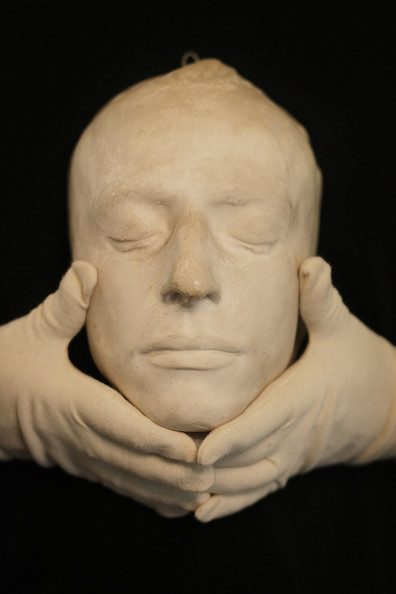
Keats finds through this nostalgic history that the urn portrays that beauty is the true significance of things in our world. Keats finds that true beauty lies in the real world of men, not merely in art. I thought it would be a good idea to include a photograph of John Keats’ death mask in this section of the post because of his realization of the fleeting nature of mortality.
By the end of "Ode on a Grecian Urn" he understands that no matter how much he thinks about the past and the things that he has leaned from history, he will never be able to return to that place. Because of this Keats must acknowledge that nostalgia can only serve as an influence to his work and he must not long for things that will never happen again.
Smith and Nostalgia

Many of Charlotte Smith’s sonnets revolve around the
nostalgia of her childhood experiences as well. However, her memories are not
quite as fond as Keats’ and Wordsworth. This is explained clearly in Doug’s
post (here) talking about Smith’s poem, “The Glow Worm.” He says, “One cannot
ignore the fact that childhood sometimes contains grim moments. Smith lures her
audience in with expectations of nostalgia, and snatches it away just as
quickly. As her sonnet claims, reality is not a place of “musing ‘tween a joy
and pain.” For Smith, there is no use finding happiness in earlier times.”
“The
Glow Worm” is a particularly morbid poem in it’s interpretation of childhood
longing for knowledge. In lines 8-14 of the poem the speaker thinks back on the
loss of innocence for a child after they learn that the beauty of the world is
fleeting. “'Star of the dewy grass!--I make thee mine!'--Then,
ere he sleep, collects 'the moisten'd' flower, And bids soft leaves his
glittering prize enfold, And dreams that Fairy-lamps illume his bower: Yet with
the morning shudders to behold His lucid treasure, rayless as the dust! --So
turn the world's bright joys to cold and blank disgust. “
According to Smith, “we can trace our origin no farther than
to the people we hate and despise.” (Gurton-Wachter).
This scholarly article refers to Smith’s commentary on France in her poem
“Beachy Head” but it can also be applied to her elegiac sonnets.
The fact that
Smith acknowledges that memory can only be traced as far back as the people we
despise suggests that nostalgia, even nostalgia that is not happy, can be
interrupted by something or someone that physically r mentally impacted our
lives. All these memories, good and bad, help to build the poet as a whole and
shape them into the adult that they become.