Showing posts with label Poets Interaction with Nature. Show all posts

Tuesday, December 11, 2012

Poet's Interaction with Nature


Throughout the semester we’ve covered collecting on various levels, whether it is nature, history, or the poet.  What stuck with me throughout the course of the semester was the poet’s interaction with nature, and how this relationship furthered the unit topic at hand.  It also allowed for an exploration of the meaning through a familiar medium, interaction with nature.  It is this perception and interaction with nature from the poet that allows the reader to understand the poet and subject matter, as well as allowing for self exploration regarding memories and morals.
                The first step in forming an opinion is the initial observation of the object, as well as the perception that you view the object with.  Perception is the first step in interacting because from the things one observes they make their decision on whether to pursue something or not.  In Gilpin’s Observations on the River Wye he discusses what can be considered picturesque.  Gilpin says that “even the deformities of one tree may be corrected by the deformities of another.  But few trees have those characters of beauty, which will enable them to appear as individuals” (Gilpin 2-3).  Gilpin says that a true good view is hard to come by, and at times one must view this beauty through a different medium (mirror, colored glass, etc) to truly have an appreciation for something so simplistic.  Gilpin’s straightforward explanation is compared to an “expansion of knowledge” whereas most poets from this era use Nature to serve as the medium. The difference in Gilpin using a medium to look at nature shows that thoughts of nature are his end-product.  When compared to Wordsworth, who uses Nature to focus internally or on larger social issues, Gilpin takes on a beginners’ level understanding of the Romantics to explain it to the everyday man.  Gilpin argues that any presence of mankind will destroy the illusion of nature and calls it “the most offensive separation of property” (6) whereas Wordsworth compares the state of nature to the decay of Tintern Abbey and the city where he presently resides.  Gilpin’s list of what makes something picturesque takes away the sense of mysticism that many people associate with the Romantic Era.

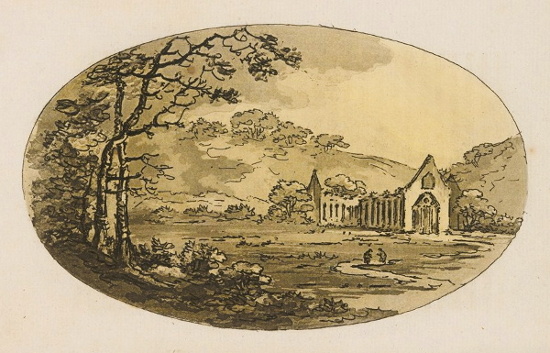
The picture above is tied in with Gilpin’s work and opinions of the picturesque.  The three distinct area, fore, middle, and background are all clearly marked.  The tree at the front of the image on the left draws in the initial attention from the audience by breaking the Rule of Thirds and placing it on the far edge of the frame.  It creates a kind of tension until the audience’s eyes work their way to the far right side of the image where they can see the house.  This creates an odd sense of balance with the empty space in the middle up for interpretation of the viewer.  The people in the lower right quadrant allow for the beginning of the story, if the reader wishes to think about what they could be doing.  Gilpin argued that something could be “perfect enough to form the perspective; yet broken enough to destroy the regularity”.  The various objects in this image work together to create an ideal, picturesque, Romantic picture. 
When looking at a poet’s interaction with Nature it is best to study Wordsworth, whose poems almost always include some engagement with nature.  In “The Prelude” Wordsworth looks back over his life and recounts memories of his childhood. As a child his interaction with nature was loud, rambunctious, and intertwined with almost every memory.  In the 1799 edition of the “The Prelude” Wordsworth writes that he “wheeled about/ Proud and exulting, like an untired horse/ That cares not for its home” (lines 154-156).  Nature helped shape him into the man that he is today.  He even says that nature helped compose his thoughts, the very core being of an individual.  As a young adult, in Lyrical Ballads, he writes “Lines Written A Few Miles Above Tintern Abbey, on Revisiting the Banks of the Wye During A Tour”.  This is a slightly more detached poem, where he reflects back on the time that has passed since he last visited Tintern Abbey, and what that memory has meant to him.

It seems important to note that Wordsworth isn’t standing next to the Abbey.  In fact, his view was probably more like this, on the other side of the Wye. When viewed from this angle the Abbey is far away and no longer the focus of the scene.  In fact, Thomas Brennan, among other critics, notes that
 “For nowhere beyond the title is the Abbey either mentioned or explicitly described.  Critics have focused on the surroundings rather than the ruins”.  This forces the audience to focus on the natural content, and not the remains of mankind.  It is this slight removal that helps emphasize the five year time difference.  A detached view affectionately remembered helps create a sense of longing and nostalgia that rings through the poem.  He still relishes in trying to relive the experience and escape from the cares of the city.  He consumed the area around him, and he even explains the difference in the landscape to him now.
                “...Haunted me like a passion; the tall rock,
                The mountain, and the deep and gloomy wood,
                Their colours and their forms, were then to me
                An appetite: a feeling and a love,
                That had no need of a remoter charm,
                By thoughts supplied an any interest
                Unborrowed from the eye.  – That time is past,
                And all its aching joys are now no more.” (lines 78-85)
Time has not stopped for Wordsworth, and he must move forward, leaving behind his naked days in the forest and growing up. 
                Similarly, six months after writing “Tintern Abbey” Wordsworth publishes the 1799 edition of “The Prelude” where he changes his opinion of nature and its partnership with memory.  Wordsworth says that “There are in our existence spots of time/ Which with distinct preeminence retain/ a fructifying virtue” (288-290) and later explains that there are some things that could never be explained because the words don’t exist to do it justice.  In class we discussed whether the actual experience or the memory is more important, and I believe that it is the memory that matters most, because that it what you will reflect on and relay to other people, but Wordsworth distinguishes himself by talking about his feelings in that moment and how it shaped him into the man he is.  Footnote 4 does a good job of summarizing the change from “Tintern Abbey” to “The Prelude” by saying that “The pantheist claims of Tintern Abbey have gone, however, the poet is not longer enabled to ‘see into the life of things”.  This makes a strong distinction.  As time progresses he distances himself more.  When evaluating other poems by Wordsworth you can see that he places the same distance between himself and his work, such as the changes in “Old Man Travelling, Animal Tranquility and Decay: A Sketch” where he slowly removes the political and social statements and instead places the focus on the reader and their experience.  For Wordsworth, it is through his interaction and observations of nature that allow him to explore his identity and reflect on who he has grown into.
                Interaction requires there to be an exchange between two things.  If the poet is interacting with Nature, then Nature must be reciprocating something to continue the cycle.  A good view of man from the opinion of nature can be found in Klinkenborg’s “Timothy; or, Notes of an Abject Reptile”.  Timothy, an old tortoise, places the reader in perspective and raises a sense of awareness of our impact on the area around us.  A walk that we can make in two strides may take him weeks; it is small acts like this that start off the story, yet as it progresses Timothy makes larger human observations.  He makes comments on our mortality (Klinkenborg 8) as well as how frantic and disarrayed our lives are (Klinkenborg 13).  Nature is a constant.  The only changes it undergoes are the four seasons, which can be predicted and expected.  Human life, from the opinion of nature, is full of surprises, twists, and turns.  It is a fleeting moment.  Despite the time that passes very little will change for nature, it shall always have the view of Tintern Abbey from the banks of the Wye, and the seasons will continue to shift for the rest of time.  Timothy comments on the difference in reality and the way that Nature and mankind both view it.  Mankind’s reality is filtered through a set of rose colored glasses, similar to Gilpin’s devices to view the picturesque, and there is very little deviance from the overall plan.  There is no room for the unexpected, such as Timothy’s voice which he says would “shatter his human solitude” (20). The words “human solitude” show that mankind has grown comfortable in their space and do not have room for something as riveting as an obscure point of view. 
                While looking over the Romantic Circles website I came across a professor’s evaluation of a class paper that sounds fascinating.  Toni Wein of California State University assigns a paper to her students on the first day of class to write an essay about their “sacred place”.  She does this to have them evaluate what is sacred to them, as well as to show the variety in student’s thoughts.  This exercise is reminiscent of the class discussions we’ve had focusing on the individualism that each person has with their memories.  Some students wrote about their couches, others a family garden or the mountains nearby.  It is this kind of self reflection that Wordsworth demanded of his readers to fully understand the connection between the poet, nature, and the audience.
                The poet’s observations and interactions with Nature relay a multitude of information, whether it is about the poet’s attitude, as with Gilpin, or the use of nature to reflect on memories passed, seen in a variety of Wordsworth’s work, or nature’s wise observations about mankind, even if they are from a tortoise.  The natural setting and the use of it in the work is critical to establish the reader’s opinion of the poet and the way they will interpret the rest of the work.  It can best be summed up by saying that “Nature defines man and in some way, man defines nature”

                Works Cited
Brennan, Thomas J. "Wordsworth's Tintern Abbey." The Explicator. Pro Quest, Sept.-Oct. 2004. Web. 11 Dec. 2012. <http://libproxy.library.unt.edu:7125/docview/216776628>.

Wein, Toni. ""Romanticism and the Sense of Place"" Romanticism, Ecology, and Pedagogy. Romantic Circles, n.d. Web. 11 Dec. 2012. <http://www.rc.umd.edu/pedagogies/commons/ecology/wein/wein_print.html>.

Picture Credit

Thursday, December 6, 2012

More about memory...

I wanted to share or rather elaborate more on some thoughts I had in class.
Nature as a backdrop seemed to be there because Wordsworth could easily go back to a memory by describing the nature he saw. He must have experienced the sublime and in the present, when writing the poem, wanted to familiarize himself with that same feeling. So in this case to think about the physical-nature-he might be able to capture what feeling he received from nature or in the presence of nature. I was actually thinking about this the other day when I felt like I don't really feel the same anymore because I don't contemplate as much or have nice feelings of melancholy (somewhat like the "guilty pleasures" we talked about in class). I wondered how could I feel like that again? Maybe if I start doing things I did back then like paint. I'm not sure what would work, but I know that when I have tried to explain this good melancholy feeling (maybe like the sublime who knows), I always start of by describing what I used to do around the time I experienced those feelings.


Recollecting Memories

The theme of nature is obviously present in Wordsworth's "The Prelude", but what about the theme of collecting? It seems that Wordsworth is recollecting childhood memories, experiences, etc. I think that by doing this, Wordsworth allows his adult self to realize the importance of these childhood memories-these memories have shaped who he is as an adult. Wordsworth really digs into the philosophical and psychological importance of these memories and relates them more specifically to society (and nature) at large. Throughout the poem, I think there are both fanciful and vitalistic views of life in "The Prelude" because Wordsworth's ideas become more developed as he gets older. I actually enjoyed the idea of recollecting memories, one because thats what this whole semester has been about-collecting, but also because don't we recollect memories in our everyday lives already?

Going in circles

I felt like I was being pulled in circles. Wordsworth pulls you through the seasons not just of the years, but of his life. I don't know what I was expecting on Tuesday when I went through it the first time, but at a second glance, I was brought back to the start of this semester and the picturesque. Each of these little gems that he remembers has some construction that is falling apart. Lines 161-174 Wordsworth states that at 14, he was thinking of these picturesque images he had collected into his memory thus far, and that upon his death bed he should like to recall them again as his last looks on life. Quite powerful, considering all the things life has to offer, that his "soul would send a longing look to you." I think I liked this best of what Wordsworth we did read. It feel as almost if he's allowing the reader to discover the passion he found as a young boy.

Who let this kid run around naked in the forest?

I liked that Wordsworth started off "The Prelude" with himself as a little boy trekking through the woods and bathing naked in the stream.  It gives a child like wonder to the wilderness he is talking about in the first stanza.  He calls himself a "savage" which I thought was an interesting choice of word.  I don't think he meant it in a negative way.  I see it as more of a destructive child, like the child in Charlotte Smith's glow worm poem.  However, he was just trampling through the woods on his own without anyone else around.  This makes it seem like as a young boy he was running around taking what he felt like from nature without appreciating nature itself.

Back to Our Roots

While reading Wordsworth's Prelude, I get the feeling that I'm getting back to what got me interested in Romantic literature in the first place - the focus on nature and its effects on the speaker, more than anything. I really liked how Wordsworth focused on small details quite often - things that normally aren't exactly significant, even when there is a focus on nature in a poem. But that focus is somewhat fleeting, for there is more of a mention of civilization and the town than nature itself, and the little bits of nature still seemed to stick out to me. I'm not sure of how Wordsworth managed this or if it was intentional at all, but I must say that I certainly enjoy it.

There is something about Wordsworth that I really enjoy. I don't know if it's his style, or his command over the thematic elements he explores, but I find myself relaxed when I read him. Which I think is quite odd, because his lack of rhyme style and seemingly sporadic shifts through time in The Prelude would indicate something that takes a little more effort to enjoy. Or in essence, a clear rhyme scheme (at least for me, ordinarily) is a definitive structure and it sort of gives me certain guidelines to follow in a poem. Normally, free verse stresses me out. But not with Wordsworth.

This poem coincides nicely with an element of our course that we explored earlier in the semester. In The Prelude, Wordsworth gives credit to Nature for the fruition of mentality of mankind. In the beginning, Wordsworth says that Nature stimulates and focuses thought, as evidenced by the stream that leads to his dreams. This sort of implies that Nature has control over mankind, yet that is not the case in the poem. 

My favorite lines of the poem are lines 122-129. The way Wordsworth describes "mighty forms that do not live like living men" is so powerful. It kind of reminds me of the way Schopenhauer describes the relationship of intelligence and will, how man uses intelligence and rationality to explain certain phenomenon, like a grid that organizes something wild. And all of this occurs because of that cliff. Man divides and affects Nature, but Nature will always recover. Man owes Nature so much, but does not truly belong. Something I'm curious about: what does the cliff represent in the poem? It stops the narrator multiple times and it seems to be the physical barrier between man and the limitless sky. Is it that Nature is okay in certain aspects, like the trees and what gives man inspiration, but somethings are not accepted? Like man's blatant ignorance of some aspects of Nature ruin the other elements?

I agree with a post further down. Wordsworth's recollection of his memories is a perfect example of collecting the self/poet. Retrospect of memory is what ultimately leads to self identity (something that Locke and Hume expound upon in their epistemological accounts).

I don't know why I see so many similarities between philosophy and elements of this class. Sorry!


Monday, December 3, 2012

Tintern Abbey 2.0

So while reading Prelude, I was struck with the same feeling that I did when I read "Tintern Abbey" for the first time.  I couldn't really place exactly what the feeling was until I got to line 298 that reads "There are in our existence spots of time / Which with distinct preeminence retain/ a fructifying virtue"  (298-290) and then read the footnote for line 294 that informs the reader that "Tintern Abbey" had been written six months prior.    "Tintern" focused more on trying to relive the experience in times of need, yet "Prelude" is more about the act of remembering and the memory itself.  I am a firm believer in the thought that the memory is more important than the actual experience because that is what you will refer back to for the rest of your life, and I feel like this poem better explains that thought.  I also really enjoyed the lines "It was in truth/ An ordinary sight, but I should need/ Colours and words that are unknown to man/ To pain the visionary dreariness" (319-322).  I've talked about it before in class, but everyone should have those awesome moments.  I don't mean "awesome" in the way that we use the word now, but in the way it was used during this time: something that induced awe.  If you were able to describe that experience then I feel that the value would be udnermined.  Those kinds of experiences shouldn't be shared.  They should be private, and I feel like that is what Wordsworth is trying to describe in this section of the poem.  Although I always walk away with more Wordsworth insight after we break it down better in class.

Connections to Nature

Wordsworth has a very dramatic way of describing his walks through the woods. I agree with Desdemona that this poem has a lot to do with how much a person can be connected to nature through memories. I think Wordsworth appreciated nature and felt like he was strongly connected to the land, a thought that is similar to the way most native Americans felt. This is the idea I get from reading the poem. On the other side, there seems to be the idea of a disconnect between nature and certain (presumably most) men. Nature and the natural elements that are mentioned in the Prelude, take on  their own personality. Like many of the romantic poets, Wordsworth uses this poem as a reflection on solitude. There is also a mystical, mysterious element to this poem, especially on page 4. The poem was interesting, but there was a lot I didn't understand, particularly at the very end of part 2. Wordsworth in Family Guy

Thursday, November 8, 2012

—William Wordsworth Presentation: Lyrical Ballads, 1800 Volume II —“Old Man Travelling"


Biographical Info
—William Wordsworth was a major English Romantic poet who, with Samuel Taylor Coleridge, helped to launch the Romantic Age in English literature with the 1798 joint publication Lyrical Ballads.
—Born: April 7, 1770, Cockermouth
—Died: April 23, 1850, Ambleside
—Siblings: Dorothy Wordsworth
—Education: St John's College, Cambridge, Hawkshead Grammar School, University of Cambridge 
———
Wordsworth and Coleridge
—1795 - Moves to Dorset with his sister Dorothy and meets Samuel Taylor Coleridge, the two become close friends.
—1797 - Friendship with Coleridge: Wordsworth and his sister Dorothy move closer to Coleridge. For a year, the two poets are in daily contact with one another, a period that proves to be a vital creative period for both of them. Wordsworth produces the poem "Tintern Abbey," and Coleridge writes "The Rime of the Ancient Mariner." They collaborate on a groundbreaking collection of poetry.
—1798 – Wordsworth and Coleridge publish Lyrical Ballads, a collection of poems written in "language really used by men," free of the "gaudiness and inane phraseology of many modern writers."34 The book sparks the Romantic Age of English literature. In a preface to the second edition, Wordsworth warns the audience that they will either love or hate his new style of poetry.
—
Images

Lyrical Ballads, 1800 Volume II


About the 1800 Edition 2nd vol of “Lyrical Ballads”
—In the second, two-volume edition of 1800, Wordsworth... expanded the Advertisement into a Preface which justified the new poetry not as experiments, but as exemplifying the principles of all good poetry... The Preface deserves its reputation as a revolutionary manifesto about the nature of poetry... [It serves] not only as a turning point in English criticism but also as a central document in modern culture" (Norton Anthology of English Literature).
—Contains all the poems in the first edition plus one additional poem in the first volume, and the first printing of the forty-one new poems in the second volume.
—Written in Grasmere, England along with the work written in Germany.
—
Publication
—Published by Joseph Cottle and Biggs of Bristol firm.
—This time the authors could not oversee the printing process because they were in the Lake District.
—They hired chemist, Humphry Davy to assist with the editing and printing. However, he did little as he was unfamiliar with the poets’ intentions with regards to the printing inquiries and was ill much of the autumn of 1800.
—Wordsworth’s communication with the printer was through letters in which he requested that the arrangement of the poems be changed after the printing process had already begun and even tried to change the title of the volume. The most significant change was the withdrawal of Coleridge’s Christabel, and was substituted by Wordsworth Michael.
—Biggs and Cottle had canceled the first print run mentioning Christable in the “Preface” delaying the publication of the new edition.
—Delays meant that Longman could not distribute the volumes in time to take advantage of the 1800 Christmas trade, and Biggs and Cottle had to rush "Michael" through the press. Inevitably, they made a big mistake: fifteen lines of the poem, crucial to the plot, were omitted, and Wordsworth complained that the volume "is throughout miserably printed," while Coleridge fumed over "an infamous Blunder of the Printer" (Butler & Green 26-31, 123-125; Healey 6).
—
1798 & 1800 Editions of “Old Man Travelling”
— In the 1798 edition, lines 17-20 are in quotation marks and spoken by the old man rather than paraphrased by the narrator.
—Title in the 1798 edition is Old Man Travelling; Animal Tranquility and Decay, A Sketch.
—In the 1800 edition, removes the quotation marks from lines 17-20 so that they are spoken by the narrator.
—Title in the 1800 edition was shortened to “Animal Tranquility and Decay: A Sketch”
—
Reception
—The immediate effect on critics was not well received overall, but it became and remains a landmark, changing the course of English literature and poetry.
—Not a best seller but sold well overall and extended in four editions between 1798-1805.
—1798 edition was not a large run, about 200 copies were sold within two years.
—The reviews were mostly favorable and the poems were reprinted many a times in magazines and miscellanies.
—1800 edition included an addition of a preface, second volume and an additional 227 pages of newly composed verse (all by Wordsworth).
—George H. Healey, "bibliographically the most complex of all Wordsworth's books.”

Current auction price for “Lyrical Ballads”
—WORDSWORTH, William; and COLERIDGE, Samuel Taylor. Lyrical Ballads. London: T. N. Longman and O. Rees, 1800. Small octavo, contemporary full calf with original red and green morocco labels. Two volumes. Housed in custom half-leather box. $14,000.
—
Sources
How Revolutionary Was Lyrical Ballads (1798-1800)?
ojs.ub.gu.se/ojs/index.php/njes/article/download/262/259
http://wordsworth.classicauthors.net/
—
The "1798 Lyrical Ballads" and the Poetics of Late Eighteenth-Century Book Production Alan D. Boehm ELH , Vol. 63, No. 2 (Summer, 1996), pp. 453-487
Published by: The Johns Hopkins University Press
Article Stable URL: http://www.jstor.org/stable/30030228
http://www.rc.umd.edu/editions/LB/preface.html#history
http://www.manhattanrarebooks.com/lyrical.htm
—

I, like many of the posts below, am not a fan of The Prologue. I do not understand the reasons why Wordsworth would revoke the creative license of his audience. I mean, I understand why he did it; he wanted to clearly (although whether The Prologue is clear is debatable) explain not only his process, but the intention behind his poetry. But the reader no longer has an individual reading. I feel a very close connection with Wordsworth's Prologue to Bowles' idea of the picturesque. He believed that it was something to be taken generally, and that the parts of the whole were not as important as the whole itself. I feel like Wordsworth comes across with this mindset, that his general concept of the poem (political themes, for example) is more important than any other individual reading that the poem could be interpreted in. It makes me feel as if Wordsworth had little to no faith in not only his audience, but in his poetry.
But The Prologue wasn't all bad. I really liked how Wordsworth explained the differences between poetry and prose and why he chose to convey his message through poetry in the first place. But I find it ironic that he eventually resorts to a very prose-like prologue to convey what he felt poetry was better at conveying.

Wednesday, November 7, 2012

"The Preface" is counter-productive

After re-reading the preface, I feel like exploring Wordsworth's supposed "process of composition," since it was the hardest for me to pinpoint what his process actually entails. From what I could gather, it consists of 4 parts: perception/inspiration, recollection, analyzing that recollection and finally writing about that perception. According to Wordsworth, it's during this recollection phase that you can analyze your inspiration and realize the emotion you felt, but by doing this, doesn't that take away from the spontaneous aspect of emotion? If you sit and contemplate your emotions before writing about them, the end result is probably different from that of the original one. This brings up numerous inquiries, such as how spontaneous is Wordsworth experience at Tinturn Abbey if he sat and pondered this emotion for several hours, maybe even days? How accurate is the emotion he felt in that moment at Tinturn Abbey if he had to put his emotions into context? It's like waking up from a dream and attempting to recollect it later on: chances are, if you don't write down what you just experienced as you awoke, you're going to miss some key elements. And that's how I feel reading now reading the Lyrical Ballads with the preface.

Thursday, November 1, 2012

Lines written at a small distance from my house

I was a little apprehensive when we were assigned to read more Wordsworth. I had a difficult time when we had to Tinturn Abbey because it was so difficult to understand. So when we had to read 100 pages of Wordsworth and Coleridge I was very nervous. However, I found that most of the poems we had to read were not that difficult to understand. Most did not have a strange metrical form, rhyme scheme, and were not   extremely convoluted. I do not mean to say that the poems did not make me think, or were simple. The Rime Ancyent  Marinere was, to say the least, a very interesting and thought provoking poem, and also a very good poem to read on Halloween. It is almost as good as reading Poe. After reading it, one of the things that  stuck in my mind was the thought of why Coleridge would choose a bird as the source for everyone's misery in the poem. Why is the act of killing the albatross so horrendous that the Marinere has to roam the world for eternity telling his tale. Also I did enjoy the poems that we were supposed  to pay attention to (Goody Blake, The thorn etc) but the poem I enjoyed the most was "Lines written at a small distance from my house". It is my favorite poem because even though it is a very simple poem it seems to reveal the most about Wordsworth. It almost seems as if this poem were private letter written by Wordsworth to his sister. I especially loved the lines:
"Love, now a universal birth,
From heart to heart is stealing,
From earth to man, from man to earth,
-It is the hour of feeling."
It seems that Wordsworth wants only to celebrate a simple moment of joy for one day.

Sunday, October 28, 2012

Wordsworth preferred over Coleridge

While reading the first 100 pages of Lyrical Ballads I felt like I was reading a book of Wordsworth with Coleridge occasionally jumping in.  I counted actually and we read 19 Wordsworth poems and 4 Coleridge, so I guess it kind of is that way.  I've previously read the two poems we were told to focus on, 'The Rime of the Ancyent Marinere" and "Goody Blake, and Harry Gill, A True Story", and I found it interesting that my opinion of the poems has switched.  I loved "Ancyent Marinere" and wasn't a fan of "Goody Blake" the first time.  I think I had idealized the former and distanced myself from the latter.  It may be that I dont' feel I learned as much the second time around in Marinere; whereas, in Goody Blake I feel that I had simply read it wrong the first time.  I wasn't a huge fan of Coleridge, but it is hard to say if I prefer Wordsworth, because there were at least 4 poems that didn't draw me in, much like Coleridge.  I think what I really enjoy is Wordsworth conversational style, like in "Lines written at a small distance from my House, and sent by my little Boy to the person whom they are addressed" which feels very light and carefree, or in" Simon Lee" which makes the point in a rather straightforward manner.  I'm interested to see if the class discussion shifts my opinion, as it normally does.

Tuesday, October 2, 2012

I found the beginning of "Reading in Detail" highly reminiscent of Gilpin's sense of the Picturesque. I wrote in my one of my blog posts about how I felt that Gilpin was admonishing the individual throughout "Observations on a River Wye." It was pretty evident, especially by Gilpin's repeated use of the term "deformity" that he felt that the Picturesque was something general and something to be taken as a whole, for most of the deformities he referred to were individual items that strayed away from their general counterparts. 

I can understand how Reynolds sees that detail and detailism can ruin the grandeur of nature and, in relevance to this discussion, the picturesque. Just like with anything of great magnitude, it is the first impression of something as a whole that communicates grandeur. Take that whole apart, break it into its individual, insignificant components, and the grandeur is lost. While I don't necessarily agree with Reynolds, I see the logic behind his argument (and maybe as a woman, it's inevitable that I don't agree, according to the article). I can also see the relationship between this thought and Plato/Aristotle, who were both concerned more about (respectively) essence rather than substance, the one over the many, quality versus quantity. 

The idea that The Sublime is beautiful as a general thing is something I think is reflective of the time. It is, I believe, why Realism (and the explication of the ugly of everyday life) and the significance of the individual in literature and art didn't rise in significance until later. Personally, I believe in the grandeur of both, of the whole and its parts--more so in the parts. For the parts can survive without the whole; it is the whole the is completely reliant on the details that compose it.

Thursday, September 27, 2012

The Case For Nature As Epic, In Brief.

One of the interesting things I noticed about Clare's "Recollections After A Ramble" is how the central premise discovered at the end of the poem seems to almost be him championing the epic manner of nature. The last stanza of the poem reference the speaker's love for the rural life, and that "These with nature shall prevail/ When epics(') war harps broke in two." Epics are a product of man; nature has no epics written about it. Dante, Milton, Homer, and Virgil do not wax eloquent for pages and pages upon the landscapes of Hell, Paradise, Troy, and Carthage; they speak upon the heroic deeds of their characters (or the justness of divine retribution in Dante's case). Clare's work for the previous pages seems intent on justifying that all the little moments of nature can be just as worthwhile as describing.

Though I think the rampant misspelling and lack of grammar may be more for the meter of the poem, I join my fellow bloggers in wishing to taking a red pen (or two or three) to the page; sadly, I must leave that task to one with more time upon their hands than I.

The Bully And The Mouse


John Clare’s poems “The Mouse’s Nest” seems to have a theme that can be described as the disturbance man cause in the natural course of nature.  The voice of the poem talks about disturbing a small ball of grass as he is walking by and noticing a nursing mouse running away from it with her baby mice still attached to her breast.  The narrator chases after the mother to get a closer look at the disturbance he caused, but the mother runs away from her babies as the narrator approaches.  It was not until the narrator went away that the mouse returned to her litter and her motherly duties she was attending to before she was disturbed.  John Clare’s pastoral like language portrays the narrator as a bully who believes he is entitled to disturb and witness the natural course of all other creatures because he is big enough to do so.  It is interesting that the mouse was also a nursing mother which gives the mouse even more sympathy for the ruckus caused by the trampling of the man walking through the field.  The mouse was ensuring the survival of her young ones while the narrator deemed it necessary to disrupt this process.

Tuesday, September 25, 2012

The Tortoise and the Hare Retold

While reading Timothy I was struck by how familiar this story felt.  It felt like a retelling of the childhood story of "The Tortoise and the Hare" and the lesson where slow and steady wins the race is slowly drilled into your brain. Especially when Timothy said "my slowness is deceptively fast".  I believe that is what makes the difference.  We feel that we have to rush around to be productive (guilty as charged) when really it is just making sure we do things correctly the first time.  I think what made Timothy truly interesting is that it was an opinion of humans from a nonhuman.  This reptile is able to garner an accurate portrayal of human life, simply by observing our behaviors.  I feel like the line " I have seen these humans in their disarray.  Far more common than any finery" (13) and I had to laugh at this outside perspective.  We like to believe that we have everyone fooled, but a tortoise that spends 1/4 of the year buried in the ground can see through it.

Monday, September 24, 2012

Timothy and I Go WAY back


I enjoyed Klinkenborg’s Timothy more than any other piece we have read. It was easier to follow. I thought it was pretty much hilarious throughout its entirety. I also felt a heavy sense of environmentalism in the narrative. From Timothy’s perspective, humans seemed to be detached from the Earth and their environment. It was like Timothy was quite literally down-to-Earth while the humans were lost in a web of beliefs and materialism. I thought that this was the biggest comment the piece made, but it did so from within a pleasant narrative about an old turtle. I enjoy the excellence of this style of writing. Also, I enjoyed White’s narrative for its close descriptions of endless details. I think he was on to something very compelling in his opinion that thoroughly observing the details of a region uncovers a history one might otherwise miss.