Showing posts with label Calliope. Show all posts

Thursday, December 13, 2012

Personal Experience

Throughout the course, we have read many different kinds of works: journal entries, poems, ballads, criticisms. All of them with different perspectives, and all meant to inspire different things to each individual reader. I think it is safe to say, that all of the writers, have either pulled from their own experiences in life, or have imagined another's experience as their own. In a way, the works that they create are instances of the picturesque. For example, Tintern Abbey, is considered to have this quality. However, it is the unique response of Wordsworth that makes it memorable. Through his voice, the audience can then interpret the lens with which Wordsworth saw the picturesque.

To help relate my point, exam this photograph:
What does it mean to you? What feeling or emotions does it inspire in you? Are you remembering a trip you took with family? How did you get there? Why does it affect you? Does is remind you of Smith's "Beachy Head"? These questions are not about the place, the memories, the people that were there with you, they are about you. What connections you are making with it. It is a very personal response, each person will have a unique experience with this photo. While they may taste of similar notes of thought, they are individual.  For me, this is a place I have never been, and where I would like to be. Even though I have never been there, I can feel the water and the sunshine. I can see the sand between my toes. It evokes a feeling of calm, as well as something that is entirely bigger than myself. Now you may take what I have said and find something more personal in it for you. This, for me, is much like reading the material for the course. Each work initiates a different response. Not only are you in the shoes of the writer and the personal experiences they are bringing to the table, but you are experiencing your own perspective on the work. To add another layer to that even, there are the footnotes with even more to learn about what exactly the authors are writing on.

Let us begin this experience with a work that displaces the unfamiliar reader with a strange situation. In Lord Byron's "The Giaour", the reader encounters a love triangle, not all that strange, but the circumstances with which Hassan is washed of any wrong doing seems barbaric... to someone who does not have the knowledge of this culture readily available. As many readers in the class like Lalababaganoosh and brightstar discover, is that this practice is completely normal in the culture and that a similar tryst happened with Byron. The last footnote in "The Giaour" explains that "the circumstance to which the story relates was not very uncommon in Turkey." In the back of the book that houses the notes, that states that the got it's "basis in Byron's affair with a young Turkish woman." Not only was Byron touring a place he could readily get his hands on the culture, but portions of his tale come from things he experienced. This realization, it seems, has turned the meaning of the poem into something entirely new. Many chalk it up to a good hook to promote his works more, however, I see it as making this fantastical story more rooted in something real, something that is relatable to a wider audience. Everyone can understand love, jealousy, and revenge. It is this relation through the reader's personal experience that then colors the connection with the story.
There were also questions about the narrator of the story. Lucky for us, the notes in the back also set up a scheme: "Byron presents the story... as an assemblage of several voices possessed of different knowledges and interests, incorporated with the poet's own meditations." Byron has attempted to take into account, the personal experiences of each of the characters. It only pushes the reader further to identify and take the position of these characters through what they have seen and experienced.

In William Wordsworth's "Tintern Abbey", the reading audience had liberties that "The Giaour" could not provide. There are numerous photos that can be viewed in order to see what Wordsworth saw.
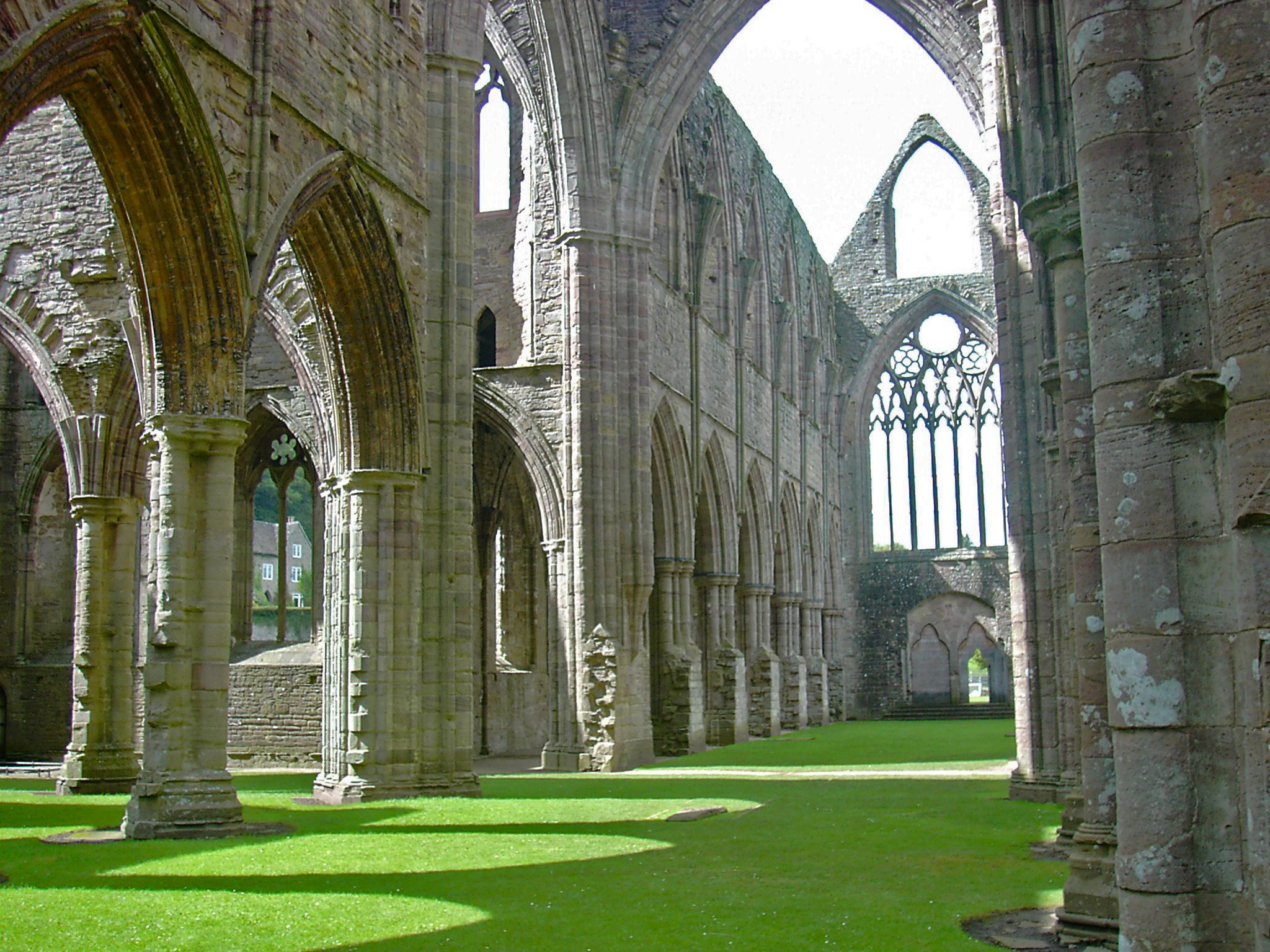
Not only are there photos, but paintings. Paintings are just as much an expression of personal experience as any poem. "Tintern Abbey" is not just a description of this picturesque place, it is a revisiting, and remembering, and a renewing. It has been five years since Wordsworth has laid eye on the ruins, and as he views them again he remembers how he viewed the abbey prior and how he has changed. He is also renewing his experience as he views his sister, Dorothy, is exposed for the first time. Wordsworth present this strange circle of seeing, collecting, remembering, and then seeing these steps happen in someone he is close with.  His personal experience and the meaning of his memories of Tintern Abbey will undoubtedly differ from those of Dorothy. In Scott Hess's "William Wordsworth and Photographic Subjectivity", he discusses how Wordsworth work is and is not like a photograph:"The photograph offers the image and only implies the subjectivity of the observer, while Wordsworth’s poetry does the opposite, concentrating on the subjectivity of the observer and only broadly gesturing at the landscape observed, but in both cases the forms and relationships of perception are structured analogously." It is the observer, or reader, in Wordsworth's poetry that make the actual meaning of the poetry. The words to initiate emotional response are there. Like a paint by numbers, Wordsworth has the portions of his poetry lined out, it is up to the reader to interpret and color the portions with the emotions of their own experiences and the experience of reading the poetry itself.

John Keats' "Ode on a Grecian Urn" pulls the center of reflection of personal experience down to the contemplation of mortality and immortality versus Wordsworth's sublime nature. In the Keats Presentation, the class learned that Keats was pretty much on his last leg of life. He had written the poems in his sick bed, as he was dying of tuberculosis. It is this experience that lends to the pain and yearning that is eclipsed in the "Ode". Michelle brought up a great point of how Keats "compares death and immortality." His own death is looming over his head, and here are these young lovers, forever emblazoned upon this Grecian Urn. This poem is Keats' own reaction with his experiences with death. As the two poems already discussed, "Ode" pulls out the reader's own memories and brushes with mortality. Keats say that the urn's "...silent form, dost tease us out of thought/As doth eternity: Cold Pastoral!" (lines 44-45). Keats is able to grasp and see the immortality that this urn has, and yet it mocks his infirm and dying body. It is cold in it's marble, lifeless yet enduring form, while his body racked with fever, hot with life, is dying. My own personal experience makes this statement extremely powerful. I have watched a loved one being slowly eaten away from cancer, each day a small death. Like a picturesque view, this topic is general enough to touch many lives and have many different views. Mavis Batey in "The Picturesque: An Overview" says that "philosopher Archibald Alison, who in his Essay on the Nature and Principles of Taste... sought to establish the 'connexion between Taste and Sensibility'. In the imaginative appreciation of beauty it was the role assigned to the association of ideas derived from personal experiences which introduced subjectivity into Alison's 'emotions of taste'." Keats appreciates the beauty of the urn, but it is his personal experience that gives it meaning and emotion.

In Charlotte Smith's "Beachy Head",  like Enargeia says, "her childhood was spent in a town, but she and her family had to move to London to live a better life and so she could be married off. In Beachy Head she says:
  'I once was happy, when while yet a child,/ I learn'd to love these upland solitudes,' but then she says 'And evil unforeseen: Early it came,/ And childhood scarcely passed, I compar'd/ With the polluted smoky atmosphere/ And dark and stifling streets...'" This speaks of her personal experience from childhood up to her lackluster marriage to a man who spent any money he could get his hands on.  It is Smith's personal strife and imprisonment that allowed her to write as she did. It is through these hardships that the reader can then relate and experience. While the poem, for most of the class, was not easy to follow or understand, the emotions that came through the text were ones that the reader could relate to based on the levels of their own experience in that particular emotional avenue.


With this last photo of Beachy Head shrouded in mist and clouds, with the sun shining above, all I can say is this: that no matter how wayward, difficult, or ridiculous the poem or work of literature may seem, there is always an emotional response of personal experience that can link you back to the subject. Through the subject you are linked to the poem and the author. It is from the personal experience with the poem that will go with you until your dying breath. It will probably not be your last thought, but time to time, something will remind you, some emotion or idea, and you will once again have an experience that is for you and you alone.


I really enjoyed the course and did not think that these were the types of conclusions and connections that I would be making throughout the material.


Works Cited

"The Giaour" by Lord Byron: Selected Poems

"Lines Written a Few Miles Above Tintern Abbey" by William Wordsworth: Lyrical Ballads 1978 and 1800
Hess, Scott. "William Wordsworth and Photographic Subjectivity." Nineteenth-Century Literature. 63.3 (2008): 283-320. Web. 11 Dec. 2012. <http://www.jstor.org/stable/10.1525/ncl.2008.63.3.283>.

"Ode on a Grecian Urn" by John Keats: Course Packet 2

Batey, Mavis. "The Picturesque: An Overview." Garden History. 22.2 (1994): 121-132. Web. 11 Dec. 2012. <http://www.jstor.org/stable/1587022 >.

"Beachy Head" by Charlotte Smith: The Poems of Charlotte Smith

Images
-Florida Sunset
http://katdish.net/wp-content/uploads/2012/07/Florida_Sunrise_099.jpg
-Tintern Abbey
 http://upload.wikimedia.org/wikipedia/commons/2/26/Tintern_Abbey-inside-2004.jpg
-Beachy Head
http://www.telegraph.co.uk/news/picturegalleries/uknews/8559488/Landscape-Photographer-of-the-Year-call-for-entries.html


Thursday, December 6, 2012

Going in circles

I felt like I was being pulled in circles. Wordsworth pulls you through the seasons not just of the years, but of his life. I don't know what I was expecting on Tuesday when I went through it the first time, but at a second glance, I was brought back to the start of this semester and the picturesque. Each of these little gems that he remembers has some construction that is falling apart. Lines 161-174 Wordsworth states that at 14, he was thinking of these picturesque images he had collected into his memory thus far, and that upon his death bed he should like to recall them again as his last looks on life. Quite powerful, considering all the things life has to offer, that his "soul would send a longing look to you." I think I liked this best of what Wordsworth we did read. It feel as almost if he's allowing the reader to discover the passion he found as a young boy.

Thursday, November 29, 2012

Fragmented Thoughts

Okay, so like a broken mirror reflecting the times- I feel I have a shattered comprehension of this tale.

Thoughts:
Religion: Hassan, even though he has taken a life will be in a Paradise in the afterlife. Doesn't quite equal out to what awaits the Giaour.
The monk and Hassan stereotypes of religion-Christian/Muslim

The butterfly: This butterfly is Leila and Greece... once too many fingers have stained it, it becomes a shade of its former glory, not even really recognizable as the brilliant object it once was. Also very fragile.

The vampire curse: I can't help but feeling like the Christian infidel/Giaour is sucking the life out of everything, leaving nothing but death and destruction in his wake.

So, Leila has died, the Giaour has a vampire curse, and is also likened to having the forehead of a Gorgon because of it's wild wreathing round, it seems to me, that our Christian Giaour is assuming mythological aspects of Greece-becoming a weird hybrid, a liminal being.

Towards the end, in the Giaour's confession, it seems that the love he had or shared with Leila is like religion.
 "Love indeed is light from heaven" (1131)

I like that at the very last bit of the poem, there is a foot note detailing a story of some twelve women accused of infidelity and were thrown into the river in sacks. It was completely acceptable (culturally) for Hassan to implement such a punishment. At first I wondered why not put the foot note with Leila's death, but I think it fits the ending better. As a reader along on this fragmented journey, how are we to know the customs of foreigners?

I feel much like a Giaour myself by the end- waiting to confess that I wish death (or at least the end of this poem) and the calm that waits after the final thought.


Eugene Delacroix; The Giaour contemplating the dead Hassan (circa 1829)

Monday, November 12, 2012

Thalaba the Destroyer

Wow. My brain hasn't been this scattered since I read House of Leaves for the first time. The footnotes were so expansive! I think there may be more footnotes than lines... Not only that, but there was another poem in the footnotes to give homage to one line Southey found beautiful enough to reproduce in his own. I do like some of the back history of the things that he discusses in the poem, but I feel he has almost taken some of the magic of his own storytelling away by telling the story again in the footnote. Maybe it is just me being neurotic, but I really dislike being told things twice within moments of each other.
Other thoughts: I enjoyed the details much more than the spoken portions.
I will also say, that after such a journey wading through footnotes and endless tale, I would read the rest of the poem to see how it ends.
Arabesque interesting fact:
Before his untimely death, Muhammad also left behind few indications about how to build proper houses of worship. With little to go on, his successors modeled Moslem holy edifices on Muhammad's house in Medina, the only construction project he'd been associated with in life. Eventually these evolved into Islamic "temples," known today as mosques ("places for prostration"), buildings designed for prayer and meditation, not for any presentation of formal services or ceremonies as in Western churches.
Among the few avenues available to artists in this context, rugs for kneeling on during prayers became a focus of creative activity, and from that was born the Persian rug. Also permitted were decorative prayer niches built into walls directing the faithful to bow toward Mecca as they prayed. But since all realistic images were forbidden in early Islam, none of these could contain images with depictions of anything in the visible world, on the reasoning that making images of animals or humans is to challenge Allah who created all things. The result was a system of ornate but non-realistic designs which Westerners eventually came to call "arabesques" (from the French for "Arabic"), which to this day characterize Arabic art throughout the world.
found here

Thursday, November 8, 2012

Old Man Travelling

Since everyone else is writing on the Prelude, I figured I try my hand at this poem and how the difference between the two versions changes the poem.
The poem is strange- it's all about observing this old man that is traveling past the speaker. The only interaction the speaker has is when his curiosity is piqued and asks the old man (15) where he is off to. This is one of two major changes between the 1798 and the 1800 version. The first directly quotes old man, whereas the latter version has the speaker retelling what the old man has said to him.
The only other change is that of the title: Old Man Travelling, Animal Tranquility and Decay, A Sketch. In 1800, Wordsworth decided to leave off "Old Man Travelling." Besides making the subject less obvious, it really points out something I didn't even pay much attention to on the first poem- Animal Tranquility and Decay. It seems to me that the nature of this man, as if he were a part of the countryside, is the real point. Line 1-2 point out that not even the birds that are pecking along the road pay attention to him; he might as well be another bird hopping along, searching.


AH! I just discovered that in 1798- his son is dying in the hospital versus 1800 he is lying in the hospital. This leads me to conclude that in the first (1798) he wants to see his son before the son dies, and different kind of journey than what I envision for the second  (1800) where his is going to his son, who in the hospital cannot travel to his father, the old man can say his goodbyes before nature final takes its toll on him. That would make a better case for the tranquility that has settled on the old man in his decay as he makes his final journey.

Wednesday, October 31, 2012

Significance of the Thorn

After reading, I found my thoughts kept coming back to why the thorn was important to the poem. I had a lot of speculation about whether it was a bigger symbol or if perhaps it was just the remnants of a rose that had been stuck into the ground-its thorns and blossom having fallen off, itself just a dead shell of what once was. This lead me to thinking that Martha Ray was also dead. What people were seeing is her ghost.
I also liked finding out through the foot notes that said Martha Ray was his friend's mother.

Tuesday, October 23, 2012

Collecting Ballads

I really enjoyed reading The Minstrelsy of the Scottish Borders because it gave me a lens in which to view the work that Scott had put forth in the world. I had never really thought about ballads in connection with folklore or fairy tales, something that is told and handed down through the generations. The extent to which Scott went searching for the originals and his detailed accounts of how these ballads moved through the people was fascinating. I was especially interested in how the ballads where written down (page 4), and how much thought and work was put in to making the ballad what it once was, "to remove obvious corruptions, and fit the ballads for press." Even the process of getting the ballads, from the border lands or from up in the mountains, you collect more of the history of the culture from whence the ballad originated. Even the very work of collecting itself, seems to me, romantic.

Wednesday, October 10, 2012

"Ode on a Grecian Urn"


I was really struck by the second stanza's "Heard melodies are sweet, but those unheard/Are sweeter". The urn cannot be heard. It is an entirely visual. It can only be seen. It is the story depicted on its curves. It is through the story that the observer hears its song.
I also like the idea that while the urn may have aged, the characters emblazoned upon it are immortal. The lovers and their love will never die (lines 17-20). The leaves will always grace the branches of the trees, for it will be an eternal Spring for them (lines 21-22).
Keats reinforces the immortality of the urn itself in the last stanza, "When old age shall this generation waste,/Thou shalt remain, in midst of other woe".
I feel that the last lines about beauty and truth reflect back on to the urn. Is the urn beautiful? Does the urn tell the truth? How does immortality fit in with truth? I can see that beauty can belong to it, as with the urn, it shall remain. But truth? Is immortality truth, when our own truth is to die? Is Keats in turn trying to become the urn by writing about it and in turn immortalizing himself within our mortal lives?
The more I think about it, the deeper I feel myself going down the rabbit hole.

Tuesday, October 2, 2012

Reading in Detail

I struggled with this piece a little, maybe it's the late hour, maybe it was the language, either way as I came to the close, I was struck with the notion that, in order to have a sense of sublime (in writing as opposed to art) there needs to be detail. The imagination is what fills in the gaps between descriptions to make a scene expressly the interpreters own. I feel that this process is what helps strike a reader as sublime. The detail is the focus and the imagination fills in the fuzzy background details.

I wish I could find the spot where it talked about how detail made the foreground become the background, but it seems to be escaping me at the moment. But to me, it seems that the details in effect can become something sublime on their own. Within the closer inspection an even smaller detail could bring a renewed sense and so on.  I don't think the devil is in the details.

Thursday, September 27, 2012

The Firetails Nest

I read this poem twice before I decided on what story it was telling me. I enjoyed the imagery of the different birds going about their daily tasks, tweeting, tootling, crying to their offspring and mate. However, the juxtaposition of this mournful Firetail, really caught me off guard. With the introduction of man into nature, I should have known that only death and destruction should follow! Poor, unfortunate mother bird, if only her blue eggs truly "in safety lie." The hedger-to his toil returns- shaping the landscape to his will, ignorant of the precious life he is destroying. Perhaps, taking away from the picturesqueness of the unfolding scene.

Overall, I think I liked these smaller poems better.

Wednesday, September 19, 2012

The Sublime and Becoming One With Nature

In the second stanza of Wordsworth's "Tintern Abbey," I feel that he is pointing out the sublime of this place with its ruins of human structure and overgrowth of nature. It is humbling to see an erection of the human species that was probably thought to last the sands of time, is yielding to the ever renewing forms of nature. It is not just the ruin and nature that speaks to and astounds Wordsworth, I feel it is also that it resembles the cycle of life, that man will one day to fall prey to nature.  "Until, the breath of this corporeal frame...we are laid asleep/in body, and become a living soul...We see into the life of things." Even once we are dead and laid to rest within the womb of nature, we inherently become one with nature in all its beauty and mystery.