Showing posts with label Escapism: Man and Nature. Show all posts

Tuesday, December 11, 2012

Escapism: Man and Nature

--> Escapism: Man and Nature

Throughout the semester, I took note of the recurring message of escapism. Many of the poems we have read deal with this subject in one aspect or another, whether it is escaping into nature in order to get away from the modernity of man’s own society, escaping into a previous time or culture in order to distance one’s self from his own culture and society, or something along a different track of escapism. In this blog essay I will focus on Walter Benjamin’s “Unpacking My Library”, Erasmus Darwin’s “The Loves of the Plants”, William Wordsworth’s “Lines Written a Few Miles above Tintern Abbey”, and John Keats’ “Ode on a Grecian Urn”. Before I get into the texts, the definition of escapism defined by Oxford Dictionaries is as follows: “the tendency to seek distraction and relief from unpleasant realities, especially by seeking entertainment or engaging in fantasy.” I wish to focus on the poets engaging in a different sort of reality as well as the reality of their everyday lives in society.

Walter Benjamin’s “Unpacking My Library” can be viewed as escapist because the very act of reading and viewing books is often considered escapism because your conscious thought is going from your own present situation into a different sort of world of someone else’s views and ideas formed with ink onto pages. The process of making a collection, whether it is of books, or seashells, or information, is, at least in my mind, a form of escapism because of the thought of getting away from the ever-present reality at hand.  Benjamin’s collection of books is also a reminder of things past, which is a heavy subject that everyone can relate to by the escapism defined by intense memories. As Fullmetal Marinna puts beautifully in her post on Monday, November 19th, 2012, “The past defines the present and instead of being a component that adds to the present, the past is its own entity and equally, if not more, valuable.” http://romanticcollecting.blogspot.com/2012/11/i-absolutely-enjoyed-reading-unpacking.html#comment-form

Erasmus Darwin’s “The Loves of the Plants” can be viewed as escapist because of the depth of Darwin’s involvement in the descriptions and the personifications of the plants he discusses and the way he is so completely attached to the subject. Whether you view the text simply as an erotic fantasy of plant mating or as a sophisticated commentary on social issues of the time (such as women’s education and rights) reading this poem and relating to it is escaping from the reality of the time. This is either because of the entrance into a sexual plant world, or because of Darwin’s forceful push into realization or at least a reminder about the injustices of the (at the time) modern society and world. In the writing of the poem, it is obvious that Darwin desires to get away from his society for a time and become completely engrossed in his intimate world of plants. As with any collector of anything, there is a deep passion for the subject. As stated previously, simply having any sort of collection is, in essence, an escape.

William Wordsworth’s “Lines Written a Few Miles above Tintern Abbey” can be viewed as an escapist poem because of the deep love of nature and of the enormous emphasis on Wordsworth’s own memories. To me, poems about nature are, more often than not, escapist. By writing about how great and wonderful and magnificent and powerful (and everything else awesome) nature is the poet is also emphasizing that these aspects are what their society is lacking. Even when the poem may have nothing to do with man and society, the praise given to nature can be contrasted with the lack of praise for man and society. The following quote perfectly exemplifies Wordsworth’s writing method dealing with all of his subjects through the collection and reflection of his memories: “The poet's theory of the unity of the mind thru childhood, youth, and maturity, the mystery of personal identity and of unbroken consciousness thru a long life, this ‘forms the basis of all his other ideas and is the point of approach to all the other main problems of ethics, art, and politics with which he deals in his poetry and prose.’ “ (J.W.B. 62) Wordsworth uses reflections of his childhood memories in order to create an escape as well as a further reflection on his identity as a poet as well as a person.

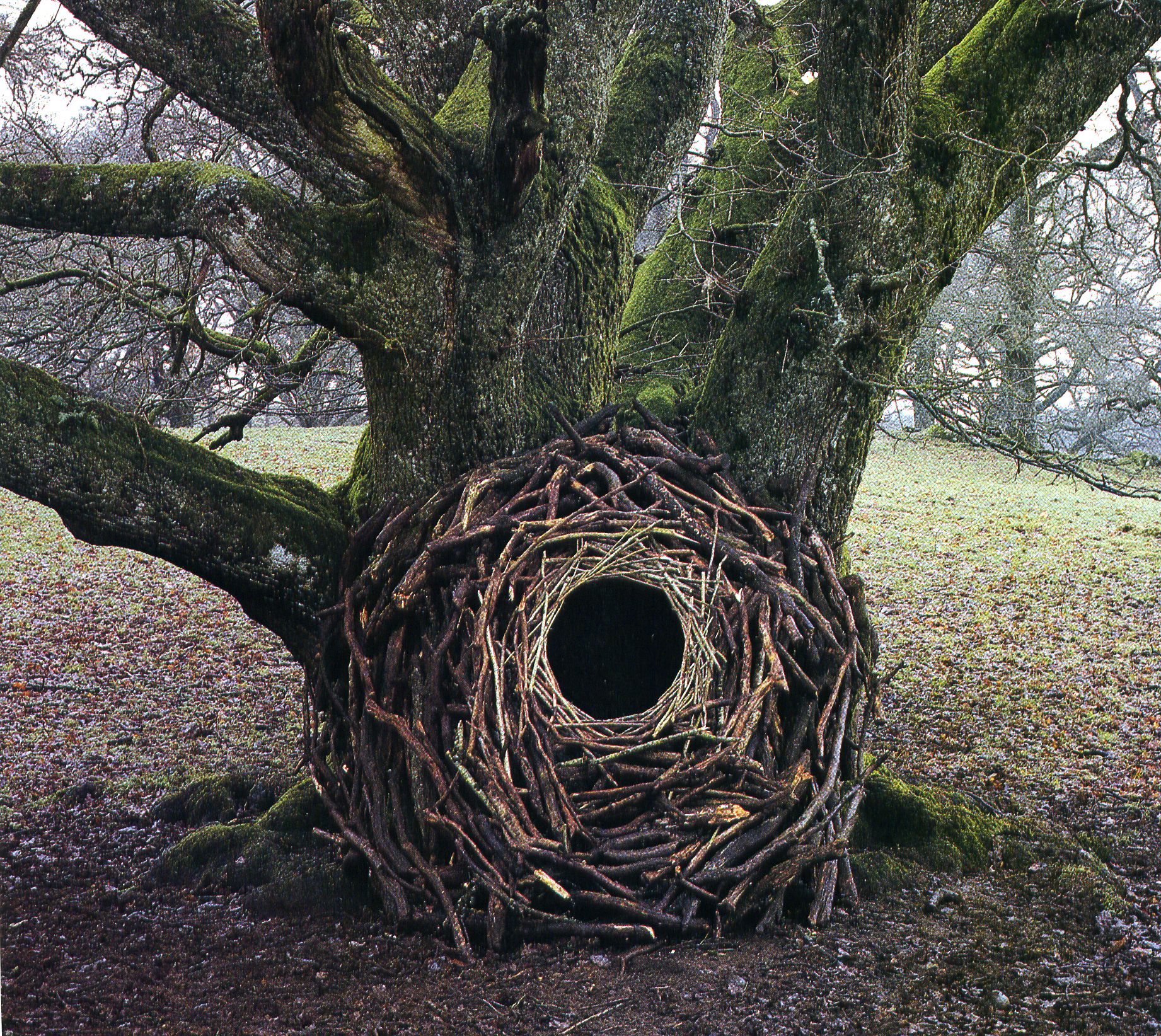
 http://inkedanimal.com/wp-content/uploads/2012/01/andy-goldsworthy-1.jpg
 
This photograph is of a piece by a British artist named Andy Goldsworthy. He makes art specific to the area he is working in at the time, and he uses only natural materials found in that area. I believe his art relates and meshes very well with the theme of escapism because his art takes the viewer out of the context of his or her own society and surroundings and into something in between man and nature. If Wordsworth had come across something like this during a walk into nature, he might appreciate the beautiful mix of man coinciding with nature. Another, slightly altered view about what Wordsworth could be escaping from comes from my own post entitled “Flying From Dread” which reads as follows: “…the whole collecting nature and the picturesque idea seems to stem from the desire to escape from the realities of the world. This is a continuing theme throughout human history; if we never wanted to have a taste of something truly fantastical, we would not be as we are. Wordsworth is expressing his desire to escape from the mundane and/or troublesome things that make up our realities.” This just goes to show that one can seek escape from many things whether it be a city, a society, or even reality itself.

John Keats’ “Ode on a Grecian Urn” can be viewed as escapism because of his clear envy and longing for the Greek culture and mythology of a time long past. I find this type of escapism to be pretty common because, as I stated in my previous post entitled “Keats’ Infatuation with an Urn”, “It just reminds me of when people talk about 'the good old days': some point in time when the speaker thinks life was better and everything was more simple in a beautiful sort of sense.” I believe, at some point, everyone has looked back into history and thought of how cool it would be to have lived in that time. The 2011 Owen Wilson movie entitled “Midnight in Paris” is a perfect example of this idea (and I think you would really enjoy watching it!) Keats’ thought of breathing life into the figures and scenes depicted on the urn shows his passion for this time period. The back and forth play between the animation of the objects and the fact that they are inanimate helps to create a sense of timelessness and immortality of the civilization and of the art itself. Further note on this idea is written as follows in a scholarly article: “…Keats animated objects empathically, projecting the passions he felt for an external object back into the object. He then portrayed the object retrospectively so that it would become expressive by means of the animation…” (Bunn 581). This play of passion between Keats and the urn further shows his desire to return a simpler or just more interesting and passionate time and place.


This image is a portrait of John Keats (doing his classic face-almost-resting-on-hand pose). The fact that he is out in nature observing his surroundings is attributed to the fact that he is a Romantic poet (obviously), as well as an escapist poet (which I don’t think is a bad thing in any way. Many of the sources I’ve looked at seem to view escapism in a negative light). We are all escapists for at least one point in our lives if not hundreds of times or even thousands.

Through these four poems as well as through much of Romanticism as a whole, escapism is an enormous topic with many different facets and niches. As a quick recap of and summary here are the themes of each of the poems discussed here when referring to escapism: Walter Benjamin’s “Unpacking My Library” uses the act of collecting and reading books as a form of escapism. Erasmus Darwin’s “The Loves of the Plants” uses the act of collecting plants and societies issues as a form of escapism. William Wordsworth’s “Lines Written a Few Miles above Tintern Abbey” uses the act of collecting nature and memories as a form of escapism. Last, but certainly not least, John Keats’ “Ode on a Grecian Urn” uses the act of collecting culture and past civilizations as a form of escapism. Long before and throughout all of the Romantic era and then onward to the present, escapism is something we simply can’t escape from.


CITATION:
  -->
TEXTS:

Benjamin, Walter. “Unpacking My Library.” Course Pack 2. 2012. 59-67. Print.

Darwin, Erasmus. “The Loves of the Plants.” Unit 1 Course Pack. 2012. 26-53. Print.

Keats, John. “Ode on a Grecian Urn.” Course Pack 2. 2012. 2. Print.

Wordsworth, William. “Lines Written a Few Miles above Tintern Abbey, on Revisiting the Banks of the Wye During a Tour, July 13, 1798.” Lyrical Ballads 1798 and 1800. Ed. Michael Gamer and Dahlia Porter. Peterborough, Ontario: Broadview, 2008.142-147. Print.

LINKS:


ARTICLES:

J.W.B. “Brief Mention.” Modern Language Notes Vol. 39, No. 1 (Jan., 1924) : 59-64. Web. 11 Dec. 2012. < http://www.jstor.org/stable/2915093>

Bunn, James H. “Keats's Ode to Psyche and the Transformation of Mental Landscape.” ELH Vol. 37, No. 4 (Dec., 1970) : 581-594. Web. 11 Dec. 2012. < http://www.jstor.org/stable/2872383>

IMAGES:


http://s2.hubimg.com/u/5412337_f520.jpg

Thursday, December 6, 2012

Getting Back to Childhood

Writing the poem looking back on his childhood and the things he often did as a child bring back some sort of nostalgia for all of us, but it is not in that point of view at all. It is still grown up Wordsworth reflecting on and telling of his childhood entwined with nature. He always has this aspect of heavy reflection on himself and others in his poetry, but sometimes I think we can reflect best by reading the actions directly.I think it would have been interesting if Wordsworth had done something from his point of view as a child and tried to capture how he actually talked and acted when he was a child. When you hear a child saying something interesting or asking questions you've never thought of, I think it can really get people thinking about it more deeply. I know this has nothing to do with his intention for the poem, and I'm not sure if I'm making any sense at this point. I guess I can say I'm okay with Wordworth, but he's a bit too lofty for me, at least at times. I don't know what I'm typing anymore. Sorry.

Wednesday, November 28, 2012

I don't like it.


With Byron’s “The Giaour” I too have experienced Dilacey’s confusion. The extent of my understanding of what’s going on is that someone died in the ocean, that someone attempted to save said person, and that this person was a kind of hero. Oh, and a bit about how awesome Greece was. Why does Greece get so much attention with the romantics? Why do Romantics find such fascination with exoticism? Southey, Byron, Wordsworth, they are all fascinated with a certain ethnographic. It strikes me as slightly disingenuous to have all this wonder manufactured around groups of people by making them exotic. Byron, being the globetrotter he thought himself to be, made a commodity so to speak of different cultures.

I don’t like this. I’ll take Scott's own brand of nationalism and fantasy over this stuff. I’ll take Clare’s earthen prose, and Darwin’s strange and weird obsession with sex and botany. 

Monday, November 19, 2012

I absolutely enjoyed reading "Unpacking my Library." One of my favorite lines is "Every passion borders on the chaotic, but the collector's passion borders on the chaos of memories" (pg. 60). 

The way the author talks about collecting as a means of remembering and almost preserving memory reminded me very much of the philosophies of John Locke, who claimed that memory is our only means of personal identity. Collecting is like a form of personal identity. 

I love what the author says about collecting as a type of rebirth and the value of old versus new. I think it's a true testament to the act of collecting that old out-values the new, especially when taking into account the influence of economy on our society. We live in a time when most people want new things and things that have evolved. We rarely see people who crave an old Nokia phone over the iPhone 5; that's just not how humanity works at this time. We live in an ever-changing, fast-paced world where new is always better. But the act of collecting, from the shells that Professor Porter brought on the first day of class, to Bowles' picturesque, to the collection of books that one of my classmates shared below, has yet to change. A collector craves, even needs, things from the past because they truly make the collection. The past defines the present and instead of being a component that adds to the present, the past is its own entity and equally, if not more, valuable. 

I love what the author says about the characteristics of a book collector. I can confidently call myself a book collector and I've done EVERYTHING he said: borrowed books with the intent of not returning them, stolen a book, and not to mention the fact that I have hundreds of books and I've only read about a third of them. Overall, I loved this piece a lot.

Just out of curiosity, when was this written? It feels somewhat modern, but I'm not sure. 

Monday, October 15, 2012

The Immortality of Art

When speaking on Keats Ode on a Grecian Urn the concept of immortality can't be expressed enough in an understanding of the work. Stanza 2 shows this most clearly when he speaks of the lovers under the tree. The young man is playing the pipes and though the two can never quite kiss "she cannot fade" and "for ever wilt thou love." Though man will grow and fade into death this urn and every scene presented is frozen in time...never progressing beyond the time it was etched into the stone.
     The final lines "Beauty is truth, truth beauty,"--that is all/Ye know on earth, and all ye need to know" and there are a few possibilities for the meaning. To me it speaks of the difference between Art and nature..or in some cases the similarities. Both are beautiful in their ways, though nature ages differently it still ages..trees die, ground washes away, even rocks erode. Art on the other hand will remain the same over a great period of time. Though it may fade even centuries later it can be seen frozen in time.

Wednesday, October 10, 2012

Keats' Infatuation with an Urn

In "Ode to a Grecian Urn" Keats seems completely in love with this urn and the contents of it's images. The people and the scenes depicted seem to be something Keats longs for, and longs to experience; like he is jealous of the it for having the things that he wants. I don't know anything about Keats or his class or lifestyle so I can't say any of my guestimations are accurate, but that is what called out to me.
The first three stanzas go from a calm mood and ease into a feeling of euphoria from seeing this "happy, happy love!" Is he jealous of it and bitter because of that? The last two stanzas enter back into a more removed, thoughtful point of view as Keats seems to wonder at the lives and scenes of this ancient urn. It just reminds me of when people talk about 'the good old days': some point in time when the speaker thinks life was better and everything was more simple in a beautiful sort of sense. Is this what Keats is thinking about the ancient Greeks?

Keats' Love of the Urn

Keats' poems seem different from the ones read thus far. I really liked how the second sonnet, "On Seeing the Elgin Marbles", was full of emotion. This was mainly because of the use of words such as "mortality", "god-like", "weep" and "die".

Keats' "Ode on a Grecian Urn" is one my favorite poems I have read while in this class. I love how Keats gives life to the scene on the urn by creating characters and settings from the 2D images. Keats seems to really envy the beauty in a moment that will never change whether in regard to lovers, a beautiful day, or the process of aging. This urn may be old but the scene depicted upon it will always remain the same. The sunny day will never become rainy, the lovers will never grow old or fall out of love. The very last line of the poem impacted me the most because of the emotional feeling it conveyed. Keats seems to have a firm grasp on what beauty truly means.

Thursday, September 20, 2012

Flying from Dread

In Tintern Abbey Wordsworth wonders almost endlessly at the beauty and glory of nature. There is his view of it at the time he wrote it and the retrospective of when he was last there. This thoughtful, pondering tone to the work made it seem like run-on thoughts, yet it was still interesting because of the detail and the content. The lines that struck me the most were lines 71-73:

...more like a man
Flying from something that he dreads, than one
Who sought the thing he loved.

These lines got to the heart of this work for me because the whole collecting nature and the picturesque idea seems to stem from the desire to escape from the realities of the world. This is a continuing theme throughout human history; if we never wanted to have a taste of something truly fantastical, we would not be as we are. Wordsworth is expressing his desire to escape from the mundane and/or troublesome things that make up our realities.

Wednesday, September 19, 2012

Change of Perspective

In Wordsworth's "Tintern Abbey" he speaks frequently of his childhood and his childhood memories. As he revisits the tranquil place that brought him so much joy, he makes a distinction between how he viewed and interacted with nature then, and how he views it now.
     
           The tall rock
           The mountain, and the deep and gloomy wood
           Their colours and their forms, were then to me
           An appetite: a feeling and a love,

His boyish wonder and innocence allowed him to see nature in a different light; he yearned for it and felt deep passion. As he comes back to the banks of the Wye, he realizes his change of perspective and although it is not the same, he is not sadden by it. He appreciates what age and life experience have brought him despite his loss of childlike outlook. He can now, "look on nature, not as in the hour / of thoughtless youth..."  In his older years, he can view nature with a deeper and more mature understanding.

Often times I had loved something as a child and then gone back to it later in my life, and felt completely different about it. It is really strange to see the evolution of your mind and how your opinions and perspective have changed. To know that something that once held so much wonder and amusement is now different to you can be disheartening, but it can also be enlightening.

Paige Lollie: Human Architect vs. Nature

If a piece of human-architect can become part of the picturesque after being overflown by nature, shouldn't the idea of the architect still be brought up? What I mean is, if the piece is totally overlooked and not described (besides being something negative) can one really say that it is part of the picturesque? When nature is described, so much detail is brought up about the nature (trees, natural stones, color, etc.) and the architect is all but disappearing into the nature, it feels like it is still consider a flaw and imperfection to the scene. If the architect has been absorbed into nature then I feel like it should be acknowledged a bit more like the other aspects are.

It it is overlooked, and not because it's been overrun by nature, than isn't the argument flawed? Why ignore something that is claimed to be part of nature?

I feel like, that while Wodsworth brings in the idea of having the Abbey near (or that it's once religious aura has touched the lands and his memories) it doesn't feel like, personally, it is given its due. But even if others feel like I am wrong or misinterpreting it, I still wonder if a human-architecture can be brought into a nature scene (painting, poem, or description) and it be described, in detail, in a positive light, and still be consider picturesque.

I might still be thinking about the paintings we saw during class on Tuesday, particularly the first and second piece. The first one is almost all nature but we could see a slight blur of ruins in the background.  It was a picture about nature and was beautiful. But though the ruins were there, they were almost invisible. And then in the second one, where there was a castle, the picture all of a sudden felt negative and dark. Can't there be ruins that aren't pushed to the side and still appreciated for natural beauty after the nature has taken over?

Wednesday, September 12, 2012

Paige Lollie: The Love of Plants

After the class on Tuesday and the discussion about art and science (how Banks might be considered) and wonder a bit more about the relationship between the two. It feels like there is a need to keep the two separate and that they are from two different classes that should not coincide, especially within the same piece of work. We might (and personally I think should) say that art is personal and is up to each individual on what art is to them. But going by a stereotypical view, not many might see science as art. And I am curious, with something like this out there, why would it be so hard to imagine the two blending well together?

What I wonder is if the nature and name of flowers were taken into account, or if the language of flowers existed at this time. So often, I hear about flowers being a symbol for an emotion or mean something outside the realm of nature (like love, purity, etc.) Does this have any meaning to the poetry itself? And would it alter the view of the poem? Because it was briefly discussed before that this poem was controversial because of a sense of intense intimacy about plant-life. So, I wonder if there could be some other meaning besides it being straight-forward-scientific.

About the notes, I am not sure if I do like them or not. It is useful to have, but there is such a great amount of information that I wonder if it really could take away from the work. Perhaps there is a limit to how many and how much there should be within footnotes? I feel like it almost loses a bit of its poetic magic when there is so much of the footnotes to cover.