Within many of the poems and tales that we have come across
within the semester, there is a theme of heroism touching upon each. Though,
perhaps, not the most obvious of topics as an author’s self or a internal
transformation, the idea of the heroic theme is incredibly important when
concerning the characters, plot, author, and some sort of political moral
standing. The hero can become the symbol of something more than an atypical man
with incredible power. He or she could stand for a society’s lack of passion or
bravery for each other or against enemies. The heroic status could represent an
author’s own personal desire for more in their life than what they originally
stand for. Or the hero within the different stories could be another process in
the heroic evolution. Thalaba the
Destroyer, The Giour, The Thorn, and the Journals of the voyages express these different sides of heroism
and appeared to be another, hidden, collection of items within the Romantic
period.
A Hero

What is a hero? The evolution of the hero has changed
throughout the centuries of literature and myth. Through oral and written
telling and generations of modernizing the idea of what a hero is has molded
and changed. The idea has gone from epic men within wars to one man on a quest
to moral knights in armor to conflicted men and women with dark tendencies. There
is no longer a simple idea or concept of what is and who can be a hero.
According to the Oxford English Dictionary; “Hero, n: A name
given (As in Homer) to men of super human strength, courage, or ability,
favored by the gods; at a later time regarded as intermediate between gods and
men, and immortal.” The original idea of a hero concentrated on the physical
strength and luck of the gods. The hero could be a flawed individual (such as
Hercules who was not the brightest or Achilles who had a deadly temper) and
could suffer a tragic fate rather than a happy ending.
Over time, the hero started to transform into a man who
embodied the moral and the good of the world and of the Christian God. This was
the stereotypical gentle white knight who would fight dragons for the fair
damsels. And finally, the more modernized hero with dark flaws and deep
emotional damage. They have become someone who is not just out to do the good
for the world, but has their own personal agenda, a corrupt desire, or many
fatal flaws.
A hero steps out of the ordinary idea of what is a human and
becomes something different, special, and perhaps tragic. Amazing and terrible things work around the
hero and prompt them on tragic or epic quests. But this is within the idea of a
literature hero. A hero is not trapped within the world of pages or
storytellers as the idea of heroism is shown through the physical ways of
battle and war.
Heroism has been commonly treated as a background assumption
in examining the nature and association of war. When ordinary men were willing
to confront attackers at the risk of death. It is facing the prospect of harm
or death for the good of life for many or for a belief. (Smirnov 1) The evolution of the hero had been
concerning the idea of war, but does the idea of war always fit within every
story or poem? No, it is through many different the following different poems
and stories that different ideas and evolutions of the hero and how it is no
longer a war-like warrior.
The following stories/poems show how the hero has become
something more and can be used as a literary device rather than just a simple
character.
The Thorn: The Needed
Hero
Wordsworth/Coleridge
One of the best examples of a hero being used as a literary device
is within the Thorn. Within the class discussion, the primary focus was on the
haunting woman and how the male figure seemed to fail within an opportunity of
heroism. There was a chance for this unknown male figure to solve the miserable
mystery of this woman and come to her aid during a time of need, however that
never happened. The man did not approach the woman out of fear and the legend
of her supposed witchcraft and crimes continued on in fearful obscurity. Within
this story, there was a need for a heroic position, but it failed to be met.
The lack of a hero was a political cry for lack of compassion and ignorance
that is curable but is never resolved. The needed hero was used as a literary
device to call for action and express a lack within the culture or within an
individual. Who was there for the damsel?
Or, perhaps, the unsung hero in the case of what the thorn
is doing. Within Desdemona Cranshaw’s post, there is the idea that the Thorn is
the “protector of the secret the weeping woman is keeping.” And Calliope brings up that there is a lot of
speculation of the thorn being a bigger symbol than how it could be read. This
opens up the option for something even more than an empty story without
meaning. If the thorn itself is the
hero, this opens up another evolving opportunity for what a hero is. Is it
simply a man who is blessed? Or could it be something more?
There is something more to a hero than just simply a human
figure who saves the day. When the lack of that figure is used, it can be a
perfect tool for a political outcry. Or, the idea of a hero could be used as an
unexpected character and call into question what defines a hero.
The Journals: The Hero Syndrome
Banks
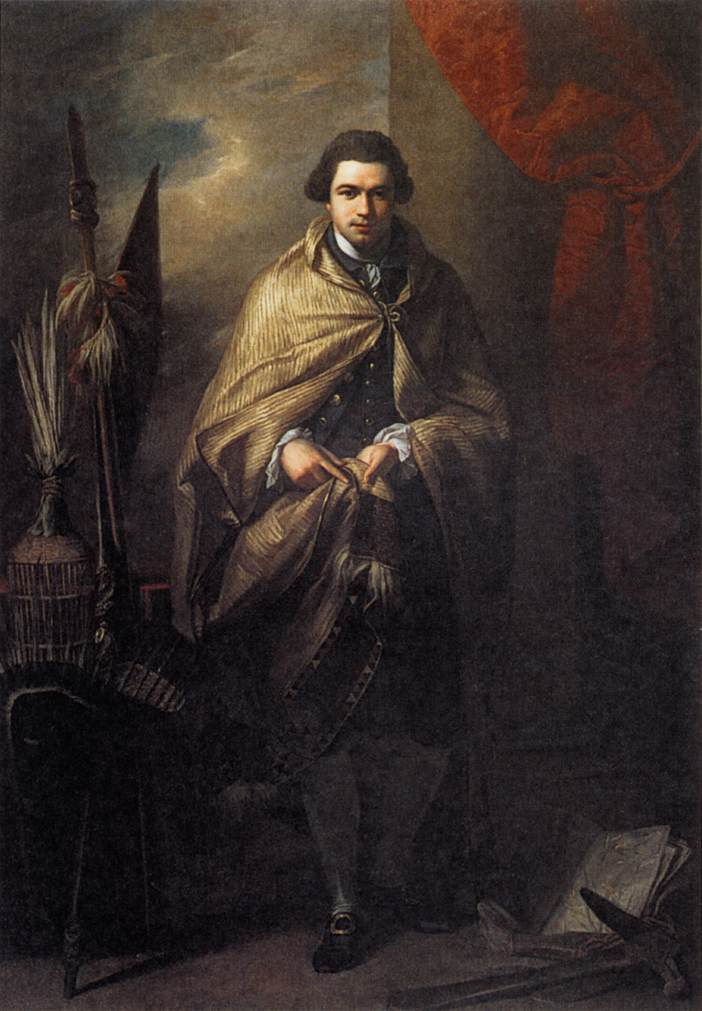
Within the literary work, the idea of a hero could easily
evolve. But the heroic idea does not only make an impact within the literary
world alone. The heroic figure has become something revered and enjoyed in the
human world. The hero became the symbolism of fame and wealth. There is a
reward system for the hero who braves an adventure; fame, glory, wealth, and
finance. An adventurer who touches dangerous land most feared can obtain heroic
statues and the benefit of that.
The desire for this status and fame can be read within many
of the works read during this semester, but it shines the most within the
Journals of Joseph Banks. As seen in his image to the right, the desire to
become something more is visible. A sweeping golden cloak, knowledge and the
world at his fingertips, Banks is creating a powerful image of himself to match
the words within his journals. It shows in his journal entries and portraits
that becoming a hero is something that would be an equivalent to the modern day
Hollywood-star.
This is an example on how the hero has evolved. It is no
longer trapped within a fantasy realm of literature but has become an
inspiration in how people should aim to live. It has become an inspiration and
a commodity. The hero sales books and the hero earns fame. Men could become the
hero of epic tales and have their names known throughout their society. The hero escapes from the bounds of paper and
touched in reality.
Thalaba the Destroyer:
The Epic Hero
Southey
The idea of the classic hero has not been taken out of the
literary field. There are still touches of the hero with a purpose within the
stories that have been read, including Thalaba the Destroyer by Southey. This
is the hero with a purpose and a blessing, who is setting out to accomplish
something more than the typical man. It is through the epic quests and the
prime concentration on the heroic character that makes it such an important
aspect within the story. Thalaba fits the scheme of the “paradigmatic heroic
tale that includes a sort of negative post-script to the achievement of the
heroic goal” (Hogan 121). Thalaba is a standout figure and is used in the most
basic style of heroism.
But Thalaba is also
used as a similar fashion how Banks used his journals. It shows a desire of the
author to reach out and become something more than a simple writer. Within the
work of Thalaba, Southey’s presence was felt and it was not just through the
many footnotes. As part of the class discussion, we covered the idea of Southey
showing who he was more than, perhaps, needed for the type of tale he was
writing. Why make such a personal presences within such a tale of the epic
hero? Because, as previously mentioned, there is something to gain for.
The Giour: The
Anti-Hero
Byron
One of the best examples of the evolution of heroes is the
Byronic hero. The change from the hero who embodied purity from a more
conflicted individual came from Byron and his heroic literary figures. He
brought in figures that could very well be considered something opposite of
heroic. It is through Byron that the anti-hero figure sees light.
Within the Giour, this image is felt with the main figure that
is confessing his sins to a monk. His heroic deed was an act of revenge and yet
he feels he would’ve done the same thing had he been in his nemesis’ place.
Typical heroes before this time did not do that. They did not think such
corrupted thoughts or desired such selfish acts. This is where the hero became
more human. Where the reader starts to think and question on the motives and
the personality of the figure who would be the hero.
The hero is a powerful literary tool that creates something
new for the story and a new way of perceiving different issues. What was once
something so simple to understand and so straightforward has evolved into
something new and modern. As shown in the stories and within the class
discussion the hero theme is incredibly important for the literary world.
Citation
Blogs
Desdemona Cranshaw: http://romanticcollecting.blogspot.com/2012/10/a-baby-and-thorn.html
Lalababaganoosh: http://romanticcollecting.blogspot.com/2012/11/byron-giaour.html
Paige Lollie: http://romanticcollecting.blogspot.com/2012/11/paige-lollie-gilgamesh-and-thalaba.html
Sites
Oxford English Dictionary
Ancestral
War and the Evolutionary Origins of "Heroism"
Oleg
Smirnov, Holly Arrow, Douglas Kennett and John Orbell
The
Journal of Politics
, Vol. 69, No. 4 (Nov., 2007), pp. 927-940
Published
by: Cambridge University Press on behalf of the Southern Political Science Association
Article
Stable URL: http://www.jstor.org/stable/4622606
The
Epilogue of Suffering: Heroism, Empathy, Ethics
Patrick
Colm Hogan
SubStance , Vol. 30, No. 1/2, Issue 94/95:
Special Issue: On the Origin of Fictions: Interdisciplinary Perspectives
(2001), pp. 119-143
Published
by: University of Wisconsin Press
Article
Stable URL: http://www.jstor.org/stable/3685508
Images

No comments:
Post a Comment