Throughout the semester we’ve
covered collecting on various levels, whether it is nature, history, or the
poet. What stuck with me throughout the
course of the semester was the poet’s interaction with nature, and how this
relationship furthered the unit topic at hand.
It also allowed for an exploration of the meaning through a familiar
medium, interaction with nature. It is
this perception and interaction with nature from the poet that allows the reader
to understand the poet and subject matter, as well as allowing for self exploration
regarding memories and morals.
The
first step in forming an opinion is the initial observation of the object, as
well as the perception that you view the object with. Perception is the first step in interacting
because from the things one observes they make their decision on whether to
pursue something or not. In Gilpin’s
Observations on the River Wye he discusses what can be considered
picturesque. Gilpin says that “even the
deformities of one tree may be corrected by the deformities of another. But few trees have those characters of
beauty, which will enable them to appear as individuals” (Gilpin 2-3). Gilpin says that a true good view is hard to
come by, and at times one must view this beauty through a different medium
(mirror, colored glass, etc) to truly have an appreciation for something so
simplistic. Gilpin’s straightforward
explanation is compared to an “expansion
of knowledge” whereas most poets from this era use Nature to serve as the
medium. The difference in Gilpin using a medium to look at nature shows that
thoughts of nature are his end-product.
When compared to Wordsworth, who uses Nature to focus internally or on
larger social issues, Gilpin takes on a beginners’ level understanding of the
Romantics to explain it to the everyday man.
Gilpin argues that any presence of mankind will destroy the illusion of
nature and calls it “the most offensive separation of property” (6) whereas
Wordsworth compares the state of nature to the decay of Tintern Abbey and the
city where he presently resides. Gilpin’s
list of what makes something picturesque takes away the sense of mysticism that
many people associate with the Romantic Era.

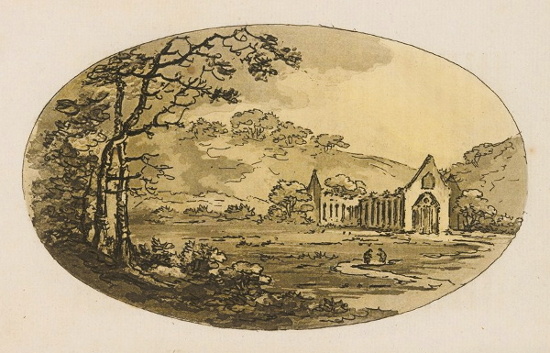
The picture above is tied in with Gilpin’s work and opinions
of the picturesque. The three distinct
area, fore, middle, and background are all clearly marked. The tree at the front of the image on the
left draws in the initial attention from the audience by breaking the Rule of Thirds
and placing it on the far edge of the frame.
It creates a kind of tension until the audience’s eyes work their way to
the far right side of the image where they can see the house. This creates an odd sense of balance with the
empty space in the middle up for interpretation of the viewer. The people in the lower right quadrant allow for
the beginning of the story, if the reader wishes to think about what they could
be doing. Gilpin argued that something
could be “perfect enough to form the perspective; yet broken enough to destroy
the regularity”. The various objects in
this image work together to create an ideal, picturesque, Romantic
picture.
When looking at a poet’s interaction with Nature it is best
to study Wordsworth, whose poems almost always include some engagement with
nature. In “The Prelude” Wordsworth
looks back over his life and recounts memories of his childhood. As a child his
interaction with nature was loud, rambunctious, and intertwined with almost
every memory. In the 1799 edition of the
“The Prelude” Wordsworth writes that he “wheeled about/ Proud and exulting,
like an untired horse/ That cares not for its home” (lines 154-156). Nature helped shape him into the man that he
is today. He even says that nature
helped compose his thoughts, the very core being of an individual. As a young adult, in Lyrical Ballads, he writes “Lines Written A Few Miles Above Tintern
Abbey, on Revisiting the Banks of the Wye During A Tour”. This is a slightly more detached poem, where
he reflects back on the time that has passed since he last visited Tintern
Abbey, and what that memory has meant to him.

It
seems important to note that Wordsworth isn’t standing next to the Abbey. In fact, his view was probably more like
this, on the other side of the Wye. When viewed from this angle the Abbey is
far away and no longer the focus of the scene.
In fact, Thomas Brennan, among other critics, notes that
“For nowhere beyond
the title is the Abbey either mentioned or explicitly described. Critics have focused on the surroundings
rather than the ruins”. This forces the
audience to focus on the natural content, and not the remains of mankind. It is this slight removal that helps emphasize
the five year time difference. A
detached view affectionately remembered helps create a sense of longing and nostalgia
that rings through the poem. He still
relishes in trying to relive the experience and escape from the cares of the
city. He consumed the area around him,
and he even explains the difference in the landscape to him now.
“...Haunted
me like a passion; the tall rock,
The mountain,
and the deep and gloomy wood,
Their
colours and their forms, were then to me
An
appetite: a feeling and a love,
That
had no need of a remoter charm,
By
thoughts supplied an any interest
Unborrowed
from the eye. – That time is past,
And all
its aching joys are now no more.” (lines 78-85)
Time has not stopped for Wordsworth, and he must move
forward, leaving behind his naked
days in the forest and growing up.
Similarly,
six months after writing “Tintern Abbey” Wordsworth publishes the 1799 edition
of “The Prelude” where he changes his opinion of nature and its partnership
with memory. Wordsworth says that “There
are in our existence spots of time/ Which with distinct preeminence retain/ a
fructifying virtue” (288-290) and later explains that there are some things that
could never be explained because the words don’t exist to do it justice. In class we discussed whether the actual experience
or the memory is more important, and I believe that it is the memory that
matters most, because that it what you will reflect on and relay to other
people, but Wordsworth distinguishes himself by talking about his feelings in
that moment and how it shaped him into the man he is. Footnote
4 does a good job of summarizing the change from “Tintern Abbey” to “The Prelude”
by saying that “The pantheist claims of Tintern
Abbey have gone, however, the poet is not longer enabled to ‘see into the
life of things”. This makes a strong distinction. As time progresses he distances himself
more. When evaluating other poems by
Wordsworth you can see that he places the same distance between himself and his
work, such as the changes in “Old Man Travelling, Animal Tranquility and Decay:
A Sketch” where he slowly removes the political and social statements and
instead places the focus on the reader and their experience. For Wordsworth, it is through his interaction
and observations of nature that allow him to explore his identity and reflect
on who he has grown into.
Interaction
requires there to be an exchange between two things. If the poet is interacting with Nature, then
Nature must be reciprocating something to continue the cycle. A good view of man from the opinion of nature
can be found in Klinkenborg’s “Timothy; or, Notes of an Abject Reptile”. Timothy, an old tortoise, places the reader
in perspective and raises a sense of awareness of our impact on the area around
us. A walk that we can make in two
strides may take him weeks; it is small acts like this that start off the
story, yet as it progresses Timothy makes larger human observations. He makes comments on our mortality (Klinkenborg
8) as well as how frantic and disarrayed our lives are (Klinkenborg 13). Nature is a constant. The only changes it undergoes are the four
seasons, which can be predicted and expected.
Human life, from the opinion of nature, is full of surprises, twists,
and turns. It is a fleeting moment. Despite the time that passes very little will
change for nature, it shall always have the view of Tintern Abbey from the
banks of the Wye, and the seasons will continue to shift for the rest of
time. Timothy comments on the difference
in reality and the way that Nature and mankind both view it. Mankind’s reality is filtered through a set
of rose colored glasses, similar to Gilpin’s devices to view the picturesque,
and there is very little deviance from the overall plan. There is no room for the unexpected, such as
Timothy’s voice which he says would “shatter his human solitude” (20). The
words “human solitude” show that mankind has grown comfortable in their space
and do not have room for something as riveting as an obscure point of
view.
While
looking over the Romantic Circles website I came across a professor’s
evaluation of a class paper that sounds fascinating. Toni Wein of California State University
assigns a paper to her students on the first day of class to write an essay
about their “sacred place”. She does
this to have them evaluate what is sacred to them, as well as to show the
variety in student’s thoughts. This
exercise is reminiscent of the class discussions we’ve had focusing on the individualism
that each person has with their memories.
Some students wrote about their couches, others a family garden or the
mountains nearby. It is this kind of
self reflection that Wordsworth demanded of his readers to fully understand the
connection between the poet, nature, and the audience.
The poet’s
observations and interactions with Nature relay a multitude of information, whether
it is about the poet’s attitude, as with Gilpin, or the use of nature to
reflect on memories passed, seen in a variety of Wordsworth’s work, or nature’s
wise observations about mankind, even if they are from a tortoise. The natural setting and the use of it in the
work is critical to establish the reader’s opinion of the poet and the way they
will interpret the rest of the work. It
can best be summed up by saying that
“Nature defines man and in some way, man defines nature”
Works
Cited
Brennan,
Thomas J. "Wordsworth's Tintern Abbey." The Explicator. Pro Quest, Sept.-Oct. 2004. Web. 11 Dec. 2012.
<http://libproxy.library.unt.edu:7125/docview/216776628>.
Wein,
Toni. ""Romanticism and the Sense of Place"" Romanticism, Ecology, and
Pedagogy. Romantic Circles, n.d. Web. 11
Dec. 2012. <http://www.rc.umd.edu/pedagogies/commons/ecology/wein/wein_print.html>.
Picture Credit


No comments:
Post a Comment