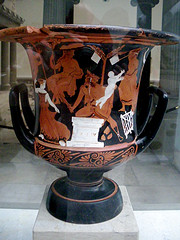
I was really struck by the second stanza's "Heard melodies are sweet, but those unheard/Are sweeter". The urn cannot be heard. It is an entirely visual. It can only be seen. It is the story depicted on its curves. It is through the story that the observer hears its song.
I also like the idea that while the urn may have aged, the characters emblazoned upon it are immortal. The lovers and their love will never die (lines 17-20). The leaves will always grace the branches of the trees, for it will be an eternal Spring for them (lines 21-22).
Keats reinforces the immortality of the urn itself in the last stanza, "When old age shall this generation waste,/Thou shalt remain, in midst of other woe".
I feel that the last lines about beauty and truth reflect back on to the urn. Is the urn beautiful? Does the urn tell the truth? How does immortality fit in with truth? I can see that beauty can belong to it, as with the urn, it shall remain. But truth? Is immortality truth, when our own truth is to die? Is Keats in turn trying to become the urn by writing about it and in turn immortalizing himself within our mortal lives?
The more I think about it, the deeper I feel myself going down the rabbit hole.

great questions!Some of your questions might be helped along by thinking about two issues: why does Keats call the urn "Cold Pastoral" in line 45? This doesn't seem like it has very positive connotations. Second, the sentiment at the end of the poem depends on where you place the quotation marks (about which there is much debate because Keats put them in two different places in different drafts of the poem). If the quote stops after "beauty," the final idea is in Keats' voice; if the quote is placed at the end of the line, the final sentiment is in the urn's voice. What difference does this make?
ReplyDelete