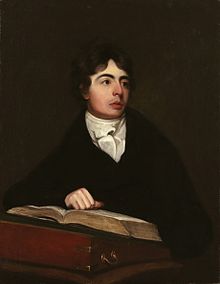
Robert Southey
Biography: He lived. He wrote. He died.
· -Southey was born on August 12, 1774 in Bristol,
England. He died on March 21, 1843 in Cumberland, England.
- He grew up mostly in Bath, England, before he
attended Westminster School in London, where he was eventually expelled for
criticizing the school’s use of corporal punishment. He later enrolled to
Oxford in 1792, where he met Coleridge.
-He shared interests in political ideology and
literature aspirations with Coleridge.
· -They wrote the verse drama The Fall of Robespierre together the same year of their meeting.
· -After leaving Oxford, Southey and Coleridge
planned to start a utopian agricultural community on the Susquehanna River in
Pennsylvania, the derivative of the term pantisocracy.
· - After marrying Edith Fricker, domestic
considerations began to erode his utopian ideals.
· - Southey was known as an Enfant Terrible, a
French term for someone who
compromises his associates or his party by unorthodox or ill-considered speech
or behavior; loosely, one who acts unconventionally.
· -Died of
brain-softening on March 21, 1843.
Publication History:
-First outlined a plan for Thalaba
in 1798 and was completed in October 1800 when Southey was in Portugal
-Sent Thalaba to his friend, John
Rickman, who agreed to act as his agent
-Published by Longman in an edition
of 1,000 copies, for which Southey received £115
-It sold slowly, and by the spring
of 1804, had only sold 500 copies
Beliefs and Thinking:
‘There are but two methods of
extending civilisation’, he claimed in 1810, ‘conquest and conversion, – the
latter the only certain one’.- Robert Southey
·
Southey was given to political and ideological
worldviews. In Southey’s formative years he took to ethical philosophers such
as Rousseau and Voltaire.
·
He later adopted Stoicism a la the philosopher
Epictetus.
·
Believed Christianity’s virtue was in the
conception of immortality and not original sin.
Discourse on Comparative Religion, or Mythopoesis:
‘Southey
perceived the East as a reservoir of stories and objects’, as ‘a material-discursive
continuum’- Diego Saglia
‘There
are but two methods of extending civilisation’, he claimed in 1810, ‘conquest
and conversion, – the latter the only certain one’.- Robert Southey
Southey had a life
long fear of "Epidemics of the
Mind," or, religious fanaticism. Ironically, he was a kind of fanatic
himself. His literary effort was to illustrate the major mythologies of the
world. He was particularly fascinated with Hindu Idolatry, seeming to find
value in the visual image of God rather than the symbolic evidence of God.
Southey's interest
in mythology went beyond symbolism to a kind of metaphysical interest. He
wanted to know how different cultures apprehended the world through the use of
myth.
“Myths were not
merely corruptions of Biblical history, as many thought, but avatars of truth
or inspiration that were worthy of being depicted in their particularity,
irrespective of any theoretical common denominator. Mythopoesis, then, was not
mere indulgence in exotic flights of fancy but part of the Romantic exploration
of human consciousness.”-Ernest Kabisch
Francis Jeffrey’s Criticism:
·
Treated Southey as a major representative of a
new movement in poetry which helped further his reputation by bringing him to
the notice of a wider public
·
He quotes Southey "...the dullest reader
cannot distort it into discord: he may read it with a prose mouth..." then
pronounces "We are afraid, there are duller readers in the world than Mr
Southey is aware of...Mr Southey must excuse us for doubting, whether even a
poet's mouth could turn these passages into good verse."
·
To the glory of the new school of poetry
"he has sacrificed greater talents and acquisitions, than can be boasted
of by any other of his associates."
Works Cited:
·
Madden, Lionel. Robert Southey: The Critical
Heritage. London and Boston: Routledge & Kegan Paul, 1972. Print.
·
Bolton, C., and W.A. Speck. The Collected
Letters of Robert Outhey. A Romantic Circles Electronic Edition. University of
Maryland, 2009. Web. 20 Nov. 2012.
<http://www.rc.umd.edu/editions/southey_letters/>.
·
photo:
http://en.wikipedia.org/wiki/File:Robert_Southey.jpg
·
http://www.poetsgraves.co.uk/southey.htm
·
Bernhardt-Kabisch, Ernest. Robert Southey.
Boston: Twayne, 1977. Print.
·
White, Daniel E. Romanticism. 2011, Vol. 17
Issue 1, p39-51. 13p. DOI: 10.3366/rom.2011.0017